# Welcome to Asymmetry Finance

<figure><img src="/files/AD969jMOsI1LoMjWTBDx" alt=""><figcaption></figcaption></figure>

Asymmetry is a DeFi Protocol for borrowing, stablecoins, and more.

## The Asymmetry Ecosystem, so far:

### Token (Governance)

* [**$ASF**](/usdasf-asymmetry-finance-token/usdasf-overview)**:**  Governing the Asymmetry Protocol, all Asymmetry Products, and more. $ASF facilitates holders to vote on governance proposals by delegating ASF akin to ‘votes’ in voting proposals, put forward by both the community and DAO members - Ultimately shaping the direction of the Asymmetry protocol going forward. ASF can be locked to receive boosted yield, revenue sharing (subject to governance vote), and more.
* [**veASF**](/usdasf-asymmetry-finance-token/veasf-governance): vote-escrowed ASF is the voting token derived from locking $ASF, Asymmetry’s native governance token.

### Stablecoins

* [**USDaf**](/usdaf-stablecoin/what-is-usdaf) is a stablecoin like never before: for the first time ever, you can set your own fixed interest rates to borrow against:
  * wBTC (Wrapped Bitcoin)
  * tBTC (Threshold Bitcoin)
  * sfrxUSD (Staked Frax Dollar)
  * sUSDS (Savings Sky Dollar)
  * scrvUSD (Savings Curve USD)
  * ysyBOLD (Yearn Savings BOLD)

Target Addressable Market of $24 billion of assets. - Powered by Liquity v2. Immutable forever.

USDaf can also be purchased in the open market at any time.

* [**AmpUSD**](/ampusd-stablecoin/how-does-ampusd-work) **(not yet live):** A groundbreaking inflation-resistant CDP stablecoin. Backed by AMPL and SPOT collateral—an industry first—**AmpUSD** offers yields averaging 15-40%, setting a new standard in stability and profitability. With customizable borrowing rates powered by Asymmetry’s exclusive Liquity v2 License, users have complete control over how they leverage their assets. USDaf is immutable by design, ensuring transparency and long-term reliability. Built in partnership with [Ampleforth](https://www.spot.cash/).&#x20;

...AmpUSD is also powered by Liquity v2. Set your own interest rates, borrow on your terms.

### Convex (CVX)

* [**afCVX**](/afcvx-asymmetry-finance-convex/afcvx-asymmetry-finance-convex) **(Asymmetry Finance Convex):** The Ultimate CVX Supercharger - Offering the highest yield of any Convex wrapper. Instant Liquidity with no mandatory 16-week lockup. **afCVX** is the first-ever instant liquidity + most efficient yield product in Convex staking.

### Ethereum LSTs

* [**afETH**](/afeth-asymmetry-finance-eth/afeth-asymmetry-finance-ethereum) **(Asymmetry Finance Ethereum):** **afETH** offers users sustainable \~10%+ yield on their ETH, \~3x the regular staking rate. Harnessing the power of the Curve and Convex ecosystems. afETH is proudly scalable and sustainable, bringing 10%+ yield on ETH in an unprecedented way. afETH is composed of Staked Frax Ethereum (sfrxETH) and Vote-Locked Convex (vlCVX). Where can you use afETH? Full integrations list [here.](/afeth-asymmetry-finance-eth/afeth-integrations)<br>
* **safETH (Simple Asymmetry Finance Ethereum): \[LEGACY]** - Asymmetry’s first product, safETH, provided a straightforward solution to decentralizing the staked Ether market, underpinned by a basket of LSTs, with a primary focus on composability, versatility, and reliability. Owning safETH grants users a piece of Rocket Pool, Frax, Swell, Ankr, and StaFi, all in one click. All the while contributing to the decentralization of the Liquid Staking market. safETH is now in withdrawal-only mode, as Asymmetry shifts its collective focus on building more innovative, higher-yield products.

*Asymmetry pioneers innovative DeFi products with key fundamentals:*

* *On-chain*
* *Verifiable*
* *Sustainable and Scalable real yield.*

### How to get involved in the ecosystem?

**Buy and lock the $ASF token (**[$ASF Overview](/usdasf-asymmetry-finance-token/usdasf-overview)), to vote on governance within the Asymmetry ecosystem, receive boosted yield, revenue sharing (subject to governance vote), and more.&#x20;

As Asymmtery's product catalog continues to grow, future products are designed with $ASF at the core of the Asymmetry ecosystem.&#x20;


# Video Guides (Walkthroughs)

How to Guides for USDaf

## Pendle USDaf Walkthrough Guide (PTs / YTs / LPs)

{% embed url="<https://www.youtube.com/watch?v=06j87L-bgIE>" %}

## Euler USDaf Walkthrough Guide

{% embed url="<https://youtu.be/x1IN7aB_omg?si=xwuFtNvAt4e5POTp>" %}

##

## opASF Walkthrough Guide

{% embed url="<https://youtu.be/bE10nwUBRm0?si=5PBUi9o9IqIHVB5N>" %}


# $ASF Overview

<figure><img src="/files/BQzokiCs01S8Hpgxg8ES" alt=""><figcaption></figcaption></figure>

**$ASF | The Asymmetry Finance Governance Token for the Asymmetry DAO.**&#x20;

[$ASF](https://x.com/search?q=%24ASF\&src=cashtag_click) - Asymmetry Finance Governance token governs all pillars of the Asymmetry ecosystem, including the groundbreaking high-yield synthetic dollars: USDaf and AmpUSD

As Asymmetry's product catalog continues to grow, future products are all designed with $ASF at the core of the ecosystem.&#x20;

Holders can:

\- Buy & lock the $ASF token

\- Vote on governance within the Asymmetry ecosystem: <https://gov.asymmetry.finance/>&#x20;

\- Revenue sharing (subject to passing governance vote)

\- Play a part in owning/controlling the Asymmetry ecosystem

\
\
**How to Buy?**

* ETH: Buy via CowSwap (Aggregator + MEV protection): <https://swap.cow.fi/#/1/swap/USDC/ASF>&#x20;
* BASE: Buy via Aerodrome: <https://aerodrome.finance/swap?to=0x7543e3829ecdd61a5fd7c187ff88c4cf46e30f73&from=eth&chain0=8453&chain1=8453> Bridge&#x20;
* ASF between ETH <> Base: <https://stargate.finance/bridge?srcChain=ethereum&srcToken=0x59a529070fBb61e6D6c91f952CcB7f35c34Cf8Aa&dstChain=base&dstToken=0x7543e3829eCDd61a5fD7c187ff88c4cf46E30F73>&#x20;
* CoinGecko (chart): <https://www.coingecko.com/en/coins/asymmetry-finance>&#x20;

**Want yield on your ASF?**&#x20;

* ASF Curve Pool LP: <https://curve.finance/dex/#/ethereum/pools/factory-twocrypto-89>&#x20;
* Peapods Finance (Volatility Farming) \[External: DYOR]: <https://peapods.finance/pod/farm/1/0x367484C763D15bb3B20f73D2681Ef5614C6A8040>&#x20;
* Helpful Peapods Guide to maximize position: <https://x.com/peapodsfinance/status/1942250937940353197><br>


# $ASF Tokenomics

**Total Supply:** 51,000,000 $ASF

**Locking Schedule**

Private Investors: Locked for 12 or 19 months, the majority at a 19-month lock, followed by a daily unlock for the following 18-24 months.&#x20;

Core Contributors: Locked for 12 months, vested over a total 4-year schedule.&#x20;

Public Sale was 100% unlocked at TGE in November 2024.

**Tokenomics:**

<figure><img src="/files/PIOnzu7SFtp3uaBEwsaZ" alt=""><figcaption></figcaption></figure>

**Emissions Schedule:**

<figure><img src="/files/g1djqARN34nQHueTAt4i" alt=""><figcaption></figcaption></figure>


# veASF (Governance)

Asymmetry’s governance revolves around veASF (vote-escrowed ASF), the voting token derived from locking $ASF, Asymmetry’s native governance token.

This enables holders of $ASF to gain governance control and revenue sharing (subject to governance vote) from key products in the ecosystem, including USDaf and AmpUSD, by locking their $ASF for veASF in return.

## **Where does Governance take place?** <a href="#id-419c" id="id-419c"></a>

<https://gov.asymmetry.finance/> is the home of Asymmetry's Governance, users can debate ideas, put forward formal proposals, and vote on existing proposals using their veASF tokens. Governance includes governing protocol parameters, fees, and treasury — Shaping the future of the Asymmetry protocol and products in a fully decentralized, democratized manner.

<figure><img src="/files/SOcMjvSsAWDiSxDZgIxs" alt=""><figcaption></figcaption></figure>

## **How veASF Works** <a href="#id-1dce" id="id-1dce"></a>

When users lock $ASF tokens, they receive veASF, which represents their governance power in the ecosystem. Inspired by the successful veCRV mechanism at the heart of Curve’s governance, veASF allows users to lock for up to 52 weeks. Unlike some vote-escrow governance models where users are subject to vote decay over time, veASF offers an effective “freeze” function that allows participants to maintain their full voting power indefinitely. To reiterate: Freezing is available at any time — Freezing will extend a lock indefinitely for maximum veASF (per ASF locked). When a user unfreezes, it will begin unlocking from 52 weeks.

Users receive 0.1 veASF per week that their $ASF is locked, with a maximum of 5.2 veASF for committing to a 52-week lock-up. This model rewards long-term commitment, giving dedicated participants a proportionally greater role in governance decisions.

The veASF contract is immutable for security purposes, and no party can edit the lock length. Users however can call the 'freeze' function at any point during their lock. The 'freeze' function max-locks user's veASF (52-weeks) and ‘freezes’, i.e., there is no vote decay on your veASF unless ‘unfreeze’ is called, which starts the 52-week countdown and vote decay of veASF. Maximizing user's governance power per ASF locked.

<figure><img src="https://miro.medium.com/v2/resize:fit:1400/0*qAvQ111EXf2ax18a" alt="" height="367" width="700"><figcaption></figcaption></figure>

## **Freeze Mechanism: No Decay with Flexibility** <a href="#ca37" id="ca37"></a>

A standout feature of Asymmetry’s governance is its flexibility through the freeze function. Users can freeze or unfreeze their $ASF lock-up period at any time. By choosing to freeze, a participant can extend their lock-up indefinitely without experiencing the gradual reduction in voting power that occurs with vote decay in other systems. This approach not only preserves voting power for long-term contributors but also offers flexibility to adapt the lock-up period based on changing governance needs or market conditions.

## **$ASF’s Role in the Asymmetry Ecosystem** <a href="#id-0350" id="id-0350"></a>

$ASF is more than a governance token; it anchors the broader Asymmetry ecosystem. All Asymmetry products are designed to generate yield independent of $ASF, thus, positioning the token to maintain stability while granting voting influence over essential aspects of Asymmetry’s growth and product direction. In comparison to the provenly unsuccessful inflationary governance token model tied to unsustainable yield products, Asymmetry has actively opted away from these for a decentralized, sustainable governance model and tokenomics design.

## **Governing Asymmetry’s Key Products** <a href="#id-6b09" id="id-6b09"></a>

Governance decisions powered by veASF influence major products like USDaf/AmplUSD. By participating in governance, veASF holders directly shape product strategies, fostering an ecosystem led by its user base. This model underscores Asymmetry’s commitment to a transparent, decentralized, and community-driven approach to growth.

## **How-To-Guide** <a href="#id-9032" id="id-9032"></a>

1. Lock the desired amount of $ASF, and choose the lock duration (or 'Max-Lock + Freeze')
2. Receive veASF proportional to the lock amount + duration
3. Use veASF to vote in Governance!
4. veASF decays over time proportional to the lock amount, once the lock-period has ended, the veASF balance will have decayed to 0.
5. Claim your original $ASF, or lock again if desired

At any point, users can opt to 'Freeze' their lock which max-locks user's veASF (52-weeks) and ‘freezes’, i.e., there is no vote decay on your veASF unless ‘unfreeze’ is called, which starts the 52-week countdown and vote decay of veASF. Maximizing user's governance power per ASF locked.

veASF tokens are locked for the user-set period aligned on every Thursday, adopting the same methodology as the Convex ecosystem. When unlocking veASF, the same rule applies, any unlocking veASF for that week will become available on that Thursday at 00:00 UTC.

## **A Vision for Sustainable Growth** <a href="#id-9032" id="id-9032"></a>

With veASF, Asymmetry champions an innovative and sustainable governance model that empowers $ASF holders without compromising flexibility. The freeze mechanism aligns long-term incentives with governance control, allowing contributors to extend their influence indefinitely. By combining yield-generating products with a robust governance system, Asymmetry’s $ASF and veASF tokens provide a foundation for growth that reflects its community’s needs and vision for the future.


# opASF (Options ASF)

This is ASF, with Options.

*It’s time to build the Asymmetry War Chest of Protocol Owned Liquidity.*

<figure><img src="/files/bXEN3p2cmPzIIsiQy3Pz" alt=""><figcaption></figcaption></figure>

## Introduction <a href="#ed15" id="ed15"></a>

In 2025, when you walk into a store, you’re used to having options lining the shelves. Endless customization, possibilities, and choice.

In 2025, when it comes to Governance Tokens, there’s rarely any variety. It’s like walking into a store and seeing the same box of chips over and over and over… and they’re stale.

Very few of them bring **real value to the protocol**, users, and ecosystem at large.

opASF changes that.

## **TL:DR (Summary):** <a href="#id-4ec6" id="id-4ec6"></a>

How it benefits the user:

Two steps:

First, opASF can be distributed as a reward for incentive programs (e.g. a new Asymmetry product, or on a new chain). Alternatively, opASF can be bought in the open market, often at a heavily discounted rate to $ASF.&#x20;

Secondly, the user can redeem their opASF for $ASF by choosing their desired unlock time (correlated to discount), and use USDaf to complete the purchase, the user will receive their ASF at net discount after their lock period. Allowing users to effectively 'go long' on $ASF, at their chosen discount/timeframe.

How it benefits the protocol:

opASF is Asymmetry’s reward derivative, modeled after Euler’s massively successful rEUL campaign and is designed to build the Asymmetry ‘War Chest’, aka Protocol Owned Liquidity of productive + revenue generating assets (**vlCVX**, **vePENDLE**, **staked LQTY**) that allows **Asymmetry to own and sustainably support its ecosystem into perpetuity**, rather than renting liquidity.&#x20;

In other words, the capital generated from opASF goes directly into effective assets that support Asymmtery products for long-term sustainablity (e.g. yield incentives for the AF Curve Stable LP, beneficial for looping USDaf).

## **The Problem: Bribing is a profitable opportunity, at what cost?** <a href="#a967" id="a967"></a>

In DeFi today, protocols use their governance tokens to incentivize certain behavior, often with the objective to increase financial upside if users stake/mint/deposit on their platform.

But at what cost?

**It’s a cat and mouse game.** The protocol must allocate tokens to try and grow faster than the cost of the incentive program itself, then pray that the users that have deposited actually like the product and stick around, even after the additional incentives have dried up.

However, time and time again, it is clear that this model is ineffective for the majority of protocols. Marc Boiron, CEO of Polygon, wrote a piece in CoinTelegraph [here](https://cointelegraph.com/news/de-fi-s-yield-model-is-broken). Rampant liquidity mining attracts mercenary capital, all while destroying token ecosystems. Simply put, that’s not sustainable.

There are a number of big name examples of this. Huge incentives to start out that attract a ton of capital. Then as the incentives fade, so does the capital. One big L1 example of this is Blast, shown below. There was no additional marginal utility that Blast brought beyond it being a place to farm, so the **TVL faded as the incentives faded.**

<figure><img src="https://miro.medium.com/v2/resize:fit:1400/0*WU4oH6GhAYzWvvNn" alt="" height="280" width="700"><figcaption><p>TVL fades as incentives fade.</p></figcaption></figure>

Specifically within the liquidity-rich Curve and Convex ecosystems, there are incentives (aka ‘bribes’). veCRV and vlCVX holders who do not have an allegiance to a specific protocol can instead ‘rent out’ their votes to the highest bidder, with great effect, averaging 20%+ paid out to vlCVX holders even through the deepest of bear markets — Users that’ve deposited into Asymmetry’s afCVX already know this game quite well.

Bribing is a game played by protocols, all trying to grow liquidity on Curve, where all stablecoin roads lead to. In addition, bribing is often more efficient than just emitting tokens to users, as often more than $1 of CRV emissions are directed towards a given per $1 of token value.

In the last Curve round (98), protocols received $1.77 (!) in incentives for every $1 spent, as shown on Votemarket below.

<figure><img src="https://miro.medium.com/v2/resize:fit:1400/0*TRj7fD-vBxTSE5yQ" alt="" height="78" width="700"><figcaption><p>Bribes are efficient.</p></figcaption></figure>

Yes, you read that right. A 77% boost for bribing through the Curve ecosystem instead of directly giving that money to users via liquidity mining.

This is incredibly efficient at face value, but there is a tradeoff. Bribes are like your buddy’s ex-wife with a spending problem — every 2 weeks, she’s back for more.

Bribes are a never ending hamster wheel that protocols must continue to run week after week. Effectively, swapping their native token for CRV emissions so that users will provide liquidity, which leads to more TVL, which leads to revenue and growth, and the cycle repeats.

But it’s a two way street… What goes up (TVL) can also go down, when those sweet rewards dry up.

Andre Cronje covered this in a [blog post](https://andrecronje.medium.com/liquidity-mining-rewards-v2-50896e44f259) that is excerpted below, pointing out a similar path and crossroads that’s been discussed in this article thus far:

*As liquidity mining grew, some, non deal-breaking, flaws became apparent. I believe the following two to be the most destressing;*

* *Liquidity locusts (or loyalty), also referred to as “stickiness”*
* *Token loyalty, or opportunistic dumping*

*Liquidity quickly disappears when incentives cease. — Andre Cronje*

## **Success Case: Euler** <a href="#a14c" id="a14c"></a>

The most recent (and most successful) case of creating protocol aligned incentives is Euler. Coming back from the hack, Euler launched and TVL was stagnant to start.

Then they unveiled rEUL, a reward style derivative token of EUL, given to users who participate in the ecosystem with a vesting schedule that spans over 6 months. Euler acquired \~450x the rewards spent in TVL. In other words, for every $1 in rEUL rewards distributed, \~$450 was deposited.

*TVL compounded \~80 % MoM for five straight months on just $2.9m of spend.*

Can you spot the moment where v2 launched, and then can you spot the moment that rEUL rewards started?

Hint: TVL goes vertical from that point onward.

<figure><img src="https://miro.medium.com/v2/resize:fit:1400/0*SCVzgkpggyrDwn3U" alt="" height="292" width="700"><figcaption><p>Euler’s program works.</p></figcaption></figure>

One feature that often goes unnoticed from the rEUL rewards program is that as users deposit, each user has their own vesting schedule. This means that sell pressure from rewards are spread over a greater timeframe. No singular unlock events.

More detailed analysis on Euler’s highly successful rewards program can be found [here](https://forum.euler.finance/t/euler-rewards-update/1145/21).

Andre had the theory. Euler put it into practice with great effect. But what if we took it one step further with game theory and the creation of a War Chest?

## **The Solution: opASF** <a href="#id-9f98" id="id-9f98"></a>

What if instead of hopping on the proverbial hamster wheel, a protocol used emissions to build a ‘War Chest’ of Protocol Owned Liquidity (POL)?

POL creates a sustainable flywheeling bag (Asymmetry’s War Chest) that continues to reward users in the ecosystem. That entrenches the protocol with sustainable liquidity that grows the protocol into perpetuity.

This is the objective of opASF.

## **The Solution: How does opASF work?** <a href="#a357" id="a357"></a>

Instead of bribing or liquidity mining purely with ASF, Asymmetry will use opASF.

opASF works like an In-The-Money call option on ASF. What does that mean?

* opASF is a derivative of ASF.
* opASF is always **1:1** redeemable for ASF at a discount. However, opASF is *not instantly redeemable* for ASF.
* When redeeming opASF for ASF, users will select a lock time. The longer the lock time, the greater the discount.
* The minimum discount is **10%**. The maximum discount is **50%**.
* The minimum lock time is **30 days**. The maximum lock time is **52 weeks.**
* Most users will receive opASF from Community Rewards (mostly LPs) programs across Curve, Convex, Pendle, Liquity, and more. However, users can purchase opASF from the open market at any time, if they wish to do so.
* If a user wishes to have instant liquidity without exercising, opASF can be sold on the open market at any time.
* opASF can only be exercised by using USDaf. If a user doesn’t have USDaf, they can zap into it seamlessly from any currency with CoW Swap
* Users can exercise opASF to receive ASF at a discount, correlated to lock duration.
* opASF also grants veASF for the duration of the unlock period, granting the user governance power and, subject to governance, revenue sharing.
* Adopting the same mechanism as Euler, opASF also has a similar system in which each position has its own vesting schedule. This means that sell pressure from rewards are spread over a greater timeframe. No singular unlock events.

Most importantly, **all revenue accrued from opASF will be used to acquire revenue generating, productive assets that will form the Asymmetry War Chest.**

Initially, the only assets whitelisted are **vlCVX**, **vePENDLE**, and **staked LQTY**. Additional assets can be voted upon via Governance in the future. The rationale behind vlCVX, vePENDLE, and staked LQTY is simple: All assets play a role in **funnelling liquidity directly into the Asymmetry ecosystem into sustainable perpetuity.**

<figure><img src="https://miro.medium.com/v2/resize:fit:1400/1*iS3OPdmdcXGotu9hPYbfLw.png" alt="" height="394" width="700"><figcaption><p>POL = Sustainble loop.</p></figcaption></figure>

## **How does opASF work in practice?** <a href="#id-782e" id="id-782e"></a>

1. Bob receives 100 opASF because he has been voting for USDaf pools using his vlCVX
2. Bob comes to the Asymmetry DApp to exercise his opASF
3. Bob selects a 6 month lock time with a 30% discount. The ASF that Bob can redeem his opASF for is worth $1,000 today
4. Bob uses $700 USDaf from his wallet to exercise his opASF. Bob notes his ASF strike price of $7.00. Bob receives 1,200 veASF and a sizeable Gem Bonus
5. In 6 months, ASF is trading at $11. Bob returns to the Asymmetry DApp and claims his 100 ASF worth $1,100, profiting $400 (57%) even though ASF only went up 10% and he only chose a 30% discount.

## **The Bottom Line: Asymmetry in Control** <a href="#df48" id="df48"></a>

opASF brings a common-sense principle from the world of traditional, revenue generating businesses outside of crypto. *To put it into other words: If you are creating a business that needs bananas in perpetuity, would you rather rent the banana trees, or own them?*

In crypto terms: Would you rather the protocol emit ASF via unsustainable bribes forever, or invest in assets that allow the protocol to control and direct the necessary liquidity into perpetuity, all with the end goal of weaning off ASF emissions entirely, ultimately benefitting holders?

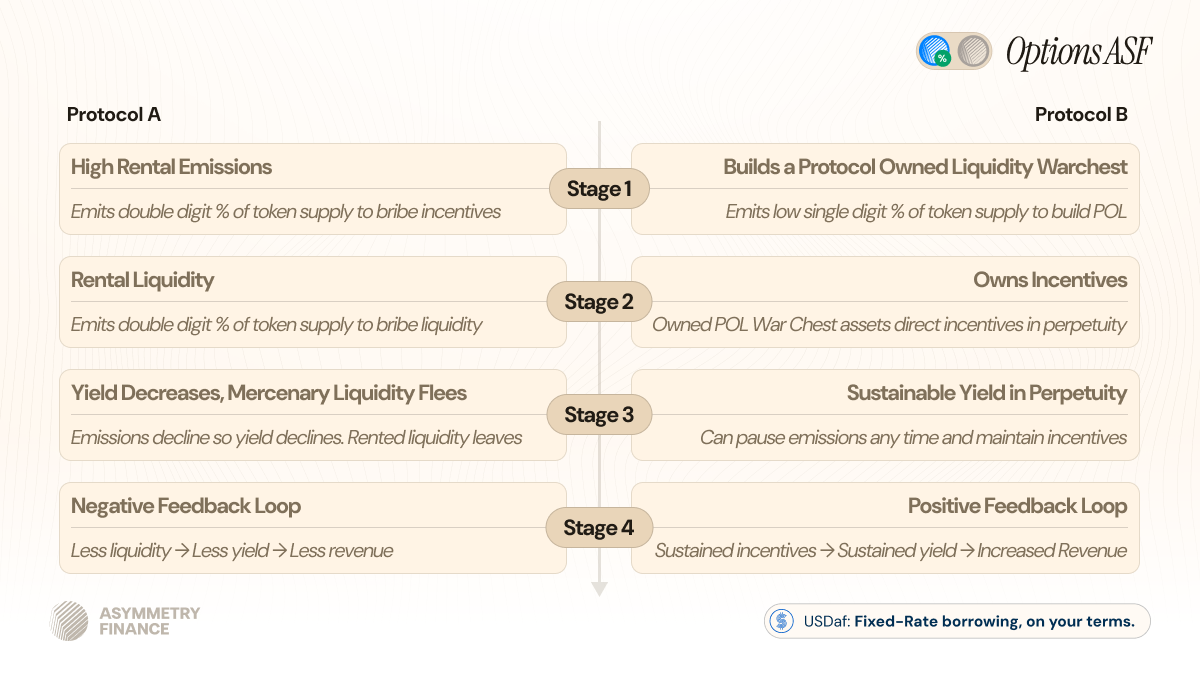
Many protocols follow Protocol A’s lead below. Asymmetry will follow Protocol B.

<figure><img src="https://miro.medium.com/v2/resize:fit:1400/1*pBiJ8wU34_dP8NFkCQynOQ.png" alt="" height="394" width="700"><figcaption><p>Protocol B is sustainable.</p></figcaption></figure>

This mechanism also rewards long term believers in the ASF ecosystem. If a user believes that ASF is undervalued and wants to align for the long term, then purchasing opASF from the open-market could make a lot of sense, depending on the discount available. In addition, a user purchasing opASF receives instant veASF (Governance) + a Gem Boost.

## **Why should I care?** <a href="#id-0e60" id="id-0e60"></a>

If you’re an ASF holder reading this, why should you care? The answer is simple. It means **Asymmetry is optimizing up for long term success.** A real revenue-generating, self-sustaining, long-term protocol learning lessons from others that came before it.

Users win, and the protocol wins by amassing productive assets. Win-win. Full circle.

No more cat-and-mouse games.

## opASF Contracts/LPs <a href="#id-0e60" id="id-0e60"></a>

0x7fE24F1A024D33506966CB7CA48Bab8c65fB632d

<https://www.curve.finance/dex/ethereum/pools/factory-twocrypto-237/deposit>

<br>


# The Gem Rush (Airdrop)

The Gem Rush has now concluded! Thanks to all that took part, and for the continued support of Asymmetry.&#x20;

There is NO CLAIM NEEDED for this Airdrop. Do not fall for scams/phishing links. Full details below:

<figure><img src="/files/5mkKp7E5CooC4KlBucnF" alt=""><figcaption></figcaption></figure>

<figure><img src="/files/0tORPTrV5DzkkKcaUUGF" alt=""><figcaption></figcaption></figure>


# Copy of The Gem Rush (Airdrop)

Re-designed, overhauled, and more interactive than ever.

<figure><img src="/files/jrBz2EmBQxtaCsQRHimo" alt=""><figcaption></figcaption></figure>

## What is the Gem Rush?

The Gem Rush is designed to reward participants in the Asymmetry ecosystem.&#x20;

Users will be able to complete Quests and refer friends to earn Gems, redeemable for a future airdrop.\ <br>

## What's new in Season 2?

Gem Rush Season 2 is a mammoth refresh to earning Gems throughout the Asymmetry ecosystem.

New quests, new ways to earn bonuses, and HUGE Gem Prizes to be won every 2 weeks!

The Gem Rush has been meticulously created with countless hours of design, math, and user-experience testing. Asymmetry’s goal for The Gem Rush is to build one of the most engaging and rewarding incentive campaigns in DeFi.

<figure><img src="/files/p7LaZYn09hiLVgeowMbf" alt=""><figcaption><p><em>Re-designed UI for Season 2</em></p></figcaption></figure>

## How do I earn Gems?

You can earn Gems in two ways: Quests and Referrals. Quests can include depositing into Asymmetry products, supplying LP, and more. Check ‘Quests’ on the Gem Rush page to find active Quests.

Quests have been overhauled in Season 2. Users can now see ‘Completed Quests’ and verify once the quest is completed!

Each quest is treated individually for quests with multipliers.

<br>

## What are Ranks?

Ranks are unlocked by Total Gem Balance.

Move up through the Ranks to unlock greater multipliers on Gem accrual! MOAR!

* Platinum: 5,000,000+ Gems
* Gold: 2,000,000+ Gems
* Silver: 500,000+ Gems
* Bronze: 50,000+ Gems
* Blue: 12,500+ Gems

<br>

## What are Multipliers?

Multipliers, simply, multiply all Gems that users accrue going forward! By unlocking Rank, users unlock a greater multiplier, increasing the rate in which users earn Gems into the future.

Season 1 OGs already have a head-start on Ranks! - To reward Season 1 OGs, Multipliers apply to existing Season 1 balances, carried forward to Season 2!

<br>

## What about Gems accrued in Season 1?

Gems earned from Season 1 are now **locked in and secured for all.**

OG Bonus: During Season 1 the 4,000 ETH TVL pool was reached! Therefore, OGs will be able to claim a 30% bonus on ALL OF THEIR GEMS EARNED SO FAR! Claimable when you enter the Asymmetry Dapp.

<figure><img src="https://lh7-rt.googleusercontent.com/docsz/AD_4nXfEiewTGTO9xCsndh2tcHFAwbowTaAW9FK16Vb-6VptsBSKpRLvHhMy0u10qDEMw8KCjVkNCpzK5Jhk9Q2h4_oAMEsx8we6xRiXW_VWEsrmEHaUVmMWli-6RAKTYTDerxYUtOdf_g?key=j79lYk-gxyo0tzd4D4Fc5b8R" alt=""><figcaption><p>30% Bonus for S1 OGs! Make sure to Claim &#x26; Enter Season 2!</p></figcaption></figure>

Users have 2 months to claim the Season 1 OG Bonus (until July 28, 2025). Make sure to enter Season 2 and explore!

Season 1 OGs already have a head-start on Ranks! To reward Season 1 OGs, Multipliers apply to existing Season 1 balances, carried forward to Season 2!

## Referrals

Referrals are simple! Active users (Users that have completed at least one quest and accrued Gems) can refer an unlimited amount of users.

Users earn 12.5% bonus Gems on ALL users referred, earning Gems weekly from the referred user's 'Accruing' figure. For example: If you are an Active User and your whale friend makes a large deposit and earns 10,000,000 Gems, you get 1,250,000 free Gems, simply for referring them, every time.

All quests can earn referral Gems with the exception of veASF, as the veASF quest earns Gems instantly, that go to user's 'Claimed' balance, not an 'Accruing' rate.

Better yet, the top referrers have a shot at ‘King of the Hill’ (below).

Users can now see ‘Total Value Referred’, plus the corresponding Gems earned from your referrals. Battle out to be the Top Referrer of the month and win BIG!

<figure><img src="/files/QYzgTWwQ9D6gI8PG09oo" alt=""><figcaption><p>Simply check your referrals, TVL referred, and your unique referral code in the top tab</p></figcaption></figure>

<br>

## Jackpot Bonus! (New for Season 2)

On the second Thursday of every month, three lucky participants from the Gem Rush leaderboard will be chosen at random to win a mammoth prize! (Prizes include $ASF and Gems!)

A minimum undisclosed Gem accrual per month is required to be entered for the Jackpot Bonus, to protect genuine earners from any sybilling attempts.

With the Jackpot Bonus, anyone can win! Minnow or whale, you’re in with a chance of the Jackpot Bonus as an active Gem earner that month.

Jackpot Bonus winners will be drawn live in the Asymmetry Discord on the second Thursday of every month!

<figure><img src="/files/PxfPYtFWtOQU3MqMX2T1" alt=""><figcaption></figcaption></figure>

<br>

## King of the Hill! (New for Season 2)

On the fourth Thursday of every month, the Top 3 Referrers of the month from the Gem Rush leaderboard will win a mammoth prize of 1 MILLION Gems for the King of the Hill, every month! 500,000 Gems and 250,000 Gems for 2nd and 3rd place respectively.

King of the Hill directly incentivizes active referrers within the Asymmetry Ecosystem!

A minimum undisclosed Gem accrual per month is required to be entered for the King of the Hill, to protect genuine earners from any sybilling attempts.

King of the Hill winners will be drawn live in the Asymmetry Discord on the fourth Thursday of every month!

How to take part? Active users can simply send their unique referral link to a friend, once a friend completes a quest, you get a bonus on their Gems and climb the Referral Leaderboard!

<figure><img src="/files/StwByAN9ATOi5pcpG4og" alt=""><figcaption></figcaption></figure>

## Gem Accrual

Gems accrue automatically, and can be claimed every Friday on the Gem Rush page.

On the Gem Rush page, users can view Gems ‘Claimed’, ‘Claimable’, and ‘Accruing’.

* Claimed = Gems already added to a user’s balance.
* Claimable = Gems ready to claim, once clicked, this will be added to a user’s ‘Claimed’ balance. This includes previous weeks too if you have yet to claim.
* Accruing = Gems that are currently being earned and will be claimable every Friday. If you have just completed a Quest, marked as completed, this accruing figure will begin the following Friday.

\*One exception is the veASF Quest, which Gems are received instantly and added to your 'Claimed' balance.<br>

## Unstaking during the Gem Rush

Gems are accrued minute-by-minute and claimable every Friday, once they are claimed, a user cannot lose them.

If a user unstakes partially/totally, they will see their ‘Claimable’ figure drop that Friday. This promotes fairness and mitigates unfair gamification of the system.&#x20;

This rule only applies to Quests that are actively earning Gems.

Gems earned from Season 1 are now locked in and secured for all!

Asymmetry reserves the right to remove any recognized sybilling attempts to promote fairness for all.

<br>

## Future Seasons & Ongoing Rewards!

Asymmetry’s philosophy is to reward participation of organic users that engage with the Asymmetry ecosystem because they want to, not because they’re incentivized through short-term rewards. The objective of the Gem Rush is to on-board new users to the Asymmetry ecosystem, and reward existing users as an additional bonus to be a part of the ecosystem.

Season 1 Gems are locked-in, and will be redeemable at the beginning of Season 3. Prioritizing rewarding the earliest adopters of Asymmetry products first in a phased approach.

It is no secret that Season 1 ran longer than originally planned. Season 2 was always planned to arrive alongside USDaf, however, with Liquity’s security upgrades this took longer to arrive. Rest assured, **Season 3 will arrive a lot sooner.**

Season 2 Gems will be redeemable at the beginning of Season 4, etc.

<figure><img src="/files/QYzgTWwQ9D6gI8PG09oo" alt=""><figcaption><p>See 'Your Ranking' and more in the 'Leaderboard' tab</p></figcaption></figure>

<br>

## Rewarding Early Users FIRST!

Asymmetry does not believe in ‘one-and-done’ airdrop campaigns, which are proven to be largely inefficient, but Asymmetry believes in correctly rewarding early participants. Asymmetry products will continue long into the future, as do the ongoing rewards.

Thanks to the new Multipliers feature, each season rewards earlier users much more than new users - you have to earn your stripes! For example, when Gems are redeemable for the airdrop, airdrop hunters that aped in days before will only receive a fraction compared to a user that’s had a smaller amount in the AF ecosystem for a longer period of time.&#x20;

The season-by-season model rewards early adopters, **Season 1 OGs have their Gems locked in**, earning a **greater multiplier on new Gems** accrued, and will be the **first to be rewarded in Season 3**.

Asymmetry continues evolving and growing, as does the Gem Rush!\ <br>

**Ready to earn?**

Dive into the Gem Rush! <https://app.asymmetry.finance/gemrush>&#x20;

<br>


# What is USDaf?

<figure><img src="/files/lZcdmB6vnUoQ5rjuBCJj" alt=""><figcaption></figcaption></figure>

For the first time ever, borrow with **customizable fixed interest rates** against Bitcoin or Stablecoins.

Borrow against:

Bitcoin

* wBTC (Wrapped Bitcoin)
* tBTC (Threshold Bitcoin)

Yield Bearing Stablecoins

* sUSDS (Savings Sky Dollar)
* sfrxUSD (Staked Frax USD)
* scrvUSD (Savings Curve USD)
* ysyBOLD (Yearn Savings BOLD)

*Target Addressable Market of $24 billion+ of assets.*

*Borrowing on your terms, custom fixed interest rates — adjustable at any time.*

[Not looking for a loan?](/usdaf-stablecoin/usdaf-without-a-loan) USDaf can be purchased in the open market and used to earn on your stables! <https://swap.cow.fi/#/1/swap/USDC/usdaf>&#x20;

USDaf is Powered by Liquity v2 — Like Liquity v1 and v2, USDaf is entirely immutable and decentralized, meaning that the system is entirely permissionless and non-upgradeable.

USDaf and the Liquity v2 codebase have been audited 10 separate times ranging from a variety of private audits (Dedaub, YAudit/Electisec, Chainsecurity, Coinspect, Certora, Recon) to public $350k audit competitions (Cantina). All audits can be found [here](/security/audits-bug-bounties).

## What is a Yield-Bearing Stablecoin?

A yield-bearing stablecoin generates passive income for its holders through mechanisms such as staking or depositing into savings contracts within decentralized finance (DeFi) protocols. These stablecoins are typically represented by specific tokens that accrue yield over time.&#x20;

When you use a yield-bearing stablecoin with USDaf, the yield you earn is IN ADDITION to the native yield of the yield-bearing stablecoin itself.&#x20;

At the time of writing, this is the native yield of each yield-bearing stablecoin:

<figure><img src="/files/GzkZJ1vqzDl53ekFcCc3" alt=""><figcaption></figcaption></figure>

## Get your Bitcoin or Yield-Bearing Stablecoins

Looking to swap into one of USDaf's collaterals?

Asymmetry recommends using **CoW Swap** (DEX) to swap into your collateral of choice, simply paste in any of the contract addresses or click the links below, then swap into your USDaf-ready collateral:

* tBTC: 0x18084fba666a33d37592fa2633fd49a74dd93a88
  * <https://swap.cow.fi/#/1/swap/USDT/tBTC>&#x20;
* wBTC: 0x2260fac5e5542a773aa44fbcfedf7c193bc2c599
  * <https://swap.cow.fi/#/1/swap/USDT/WBTC>&#x20;
* sfrxUSD: 0xcf62f905562626cfcdd2261162a51fd02fc9c5b6
  * <https://swap.cow.fi/#/1/swap/USDT/sfrxUSD>
* scrvUSD: 0x0655977FEb2f289A4aB78af67BAB0d17aAb84367
  * <https://swap.cow.fi/#/1/swap/USDT/scrvUSD>
* sUSDS: 0xa3931d71877c0e7a3148cb7eb4463524fec27fbd
  * <https://swap.cow.fi/#/1/swap/USDT/sUSDS>
* ysyBOLD: 0x23346B04a7f55b8760E5860AA5A77383D63491cD
  * for ysyBOLD, the following process is recommended:
    * BOLD: <https://swap.cow.fi/#/1/swap/USDT/BOLD>
    * Go to Yearn's BOLD Vault: <https://yearn.fi/v3/1/0x9F4330700a36B29952869fac9b33f45EEdd8A3d8>&#x20;
    * Deposit BOLD for yBOLD
    * Stake yBOLD and receive ysyBOLD


# Borrowing

USDaf can be minted by borrowing against the 8 collateral assets, USDaf can also be purchased in the open market at any time.

With USDaf, users can select their own interest rate and LTV, opening up a trove. Users can manage or update their troves at any time.

It is strongly advised to use USDaf only with Asymmetry’s UX as a safety precaution, beware of impersonating sites. Official site is: <https://usdaf.asymmetry.finance/>&#x20;

## What is a Trove?

A Trove is Liquity’s version of a 'vault'. Each Trove is linked to an Ethereum address, and each address can have multiple Troves.

Each Trove allows you to manage a loan, adjusting collateral and debt values as needed, as well as setting your own interest rate.

## Is there a minimum borrow amount?

Yes, a minimum debt of 2,000 USDaf is required for borrowing.<br>

## When do I need to pay back my loan?

Loans issued by the protocol do not have a repayment schedule. Users can leave their Trove open and repay debt any time, as long as a healthy Loan-to-Value (LTV) is maintained.

## How do I decide my LTV?

This depends on personal preference to individual risk tolerance and how actively a user wants to manage their position(s). To help with the decision, there are preset options and tooltips on the user interface that can serve as a guide.

Maximum LTVs are limited to what is on the dApp front-end displays: 83.33% for Stablecoins and 66.67% for BTC options.<br>

<figure><img src="/files/S7XIGMivizNLj3S8PO3T" alt=""><figcaption></figcaption></figure>

Please note that these examples are for illustration purposes only and do not represent definitive risk or safety thresholds. It's essential to determine one's own risk tolerance and comfort level as a user.

If a user's LTV becomes too high, the position will be liquidated.

## Technical Considerations

The Liquity v2 codebase requires all collaterals to have 18 decimals for precision. Two of the collaterals in USDaf natively only have 8 decimals (wBTC, cbBTC). In order to safely allow these collaterals to be deposited into USDaf, they must have 18 decimals. The solution for this is simple, both collaterals are seamlessly and simply wrapped (again) when users deposit. Any alternate solutions would require modifying the secure Liquity v2 codebase.

The process is seamless and will feel exactly the same as depositing any other collateral. Users will not see an additional transaction pop up as the wrapping process is bundled into their deposit or withdrawal transaction. The wrapper contracts are incredibly simple and are inhereted from OpenZeppelin's standard ERC20Wrapper.sol contract. In addition to this being a standard ERC20 library, the wrapper contracts have been audited twice by Electisec to ensure the utmost security.


# Liquidations

## How do Liquidations work?

Troves get liquidated if the LTV goes above the maximum value

USDaf uses Stability Pools as its primary liquidation mechanism to absorb liquidated debt and collateral. Each borrow-market has its own dedicated Stability Pool earning liquidation gains (in the respective collateral) in exchange for burning debt.

Just-In-Time liquidations and a redistribution of debt and collateral across borrowers of the same market handle liquidations as a last resort when the Stability Pool is empty.

A liquidated borrower usually incurs a penalty of 5% and will be able to claim the remaining collateral after liquidation.

A special case is when a Redistribution is necessary, then the loss amounts to 10% of the debt (at most). That corresponds to a max. loss of 9.09% expressed in terms of collateral.

## How am I compensated for liquidating a Trove?

The liquidation of Troves is connected with certain gas costs which the initiator has to cover. The protocol offers a gas compensation given by the following formula:

`0.0375 WETH + min(0.5% trove_collateral, 2_units_of_BTC_or_Stable)`

The 0.0375 WETH is funded by a[ refundable gas deposit](https://docs.liquity.org/v2-faq/borrowing-and-liquidations#what-is-the-refundable-gas-deposit) while the variable 0.5% part comes from the liquidated collateral, slightly reducing the liquidation gain for Stability Providers.

## What is the refundable gas deposit?

To open a new Trove, the protocol requires a liquidation reserve of 0.0375 ETH regardless of the chosen collateral, which is set aside to cover the gas costs of a potential liquidation. The deposit is returned when the Trove is closed by the user (including upon redemptions).

## How much will I pay for a loan?

In Liquity V2, there are no upfront fees. Instead, users pay interest on an ongoing basis, making it suitable for short-term loans as well.

The interest paid is determined by the rate set by the user. For example, if a user borrow 10,000 USDaf at a 5% interest rate, that user pays \~500 USDaf in interest after one year. This interest is added to the outstanding debt.

<br>


# Redemptions

## What are redemptions?

Redemptions are NOT Liquidations. Redemptions can be viewed as automatic peg maintenance, whereas liquidations makes sure the system never carries bad debt.

Redemptions allow USDaf holders to exchange their tokens for underlying collateral at a 1:1 rate. This mechanism helps maintain the peg by ensuring USDaf’s intrinsic value remains stable.

Redemptions serve the crucial purpose of keeping USDaf pegged to the US Dollar, creating a price floor around $1. They do this in a decentralized way without reliance on centralized assets or 3rd parties.

A redemption is essentially swapping USDaf for collateral at face value, as if 1 USDaf is exactly worth $1. Redemptions can be initiated by anyone, but are only profitable when USDaf <$1.&#x20;

The redeemer sends USDaf to the protocol and in return gets a mix of USDaf's six collaterals (minus the redemption fee). The redeemed amount is split among the different collateral assets based on their current Stability Pool backing (see link for more info).

Liquity also has a [video explainer](https://youtu.be/CQVmjFx987A?si=S1q-lWkkiFxKOdtP) on Redemptions.

\
Below are four examples of partial and full redemptions with BTC and Stable collateral. Note that these examples are slightly simplified for sake of demonstration.

<div><figure><img src="/files/2HFe8jbv0sLF3yTGcCIk" alt=""><figcaption></figcaption></figure> <figure><img src="/files/yqfqbdHq1LImUpXEbXvO" alt=""><figcaption></figcaption></figure> <figure><img src="/files/MXFz9CuZCDitoh16MEAu" alt=""><figcaption></figcaption></figure> <figure><img src="/files/XoxOj8S9vguW6wngXmgj" alt=""><figcaption></figcaption></figure></div>

## When can redemptions occur?

A redemption can occur at any time, but will likely only happen when it is profitable to do so. This is usually the case when the price of USDaf is less than $1 (minus the current redemption fee).

## Who can initiate a redemption?

Any Ethereum address can initiate a redemption, provided that they have a sufficient amount of USDaf to do so. However, it is expected that redemptions to be mainly performed by professional bots rather than humans.<br>

## What happens if my Trove gets redeemed?

Think of redemptions as if somebody else is repaying your debt and retrieving an equivalent amount of your collateral in return.

If your collateral is redeemed, an equivalent amount of your debt in USD terms is repaid. The redeemer receives your collateral, less the redemption fee, which remains  in your Trove. This means that at the time of redemption you have not lost any money in USD terms, likely even made a small gain with the received redemption fee as the peg recovers.

Example with BTC at $100,000:

* Before the redemption: 1 wBTC collateral, 40,000 USDaf debt, 40,000 USDaf in your wallet
* After the redemption: 0.8 wBTC collateral, 20,000 USDaf debt, 40,000 USDaf in your wallet, plus the 0.025 ETH redemption fee.

You can see your collateral and debt reduced equally (in USD terms) and the redemption fee (0.025 ETH) being added to your collateral value.

Partially affected Troves whose debt stays above the minimum debt threshold of 2,000 USDaf continue to work as before, while Troves whose debt is reduced to a lesser amount (or 0) switch to a dormant operating mode.

<br>

## How do redemptions work using six collateral assets?

USDaf is backed by a multitude of collaterals. Instead of letting the redeemer freely choose the collateral to redeem, Liquity V2 optimizes the process for economic safety. Redemptions are thus serviced through a collateral mix in a way that enhances the overall backing of USDaf.

The process starts with the Troves paying the lowest interest rates in each collateral market and continues until the full amount of USDaf is exchanged for collateral assets. Redemptions can be partial or full, as illustrated below.

In this simplified example with just three collaterals, the wBTC market shows a full redemption of the first Trove and a partial redemption of the second. The sUSDe and sDAI markets have one partial and two full redemptions, respectively.

<figure><img src="/files/gdomrm8hpvLN7f4zN09z" alt=""><figcaption></figcaption></figure>

## How is the collateral split determined?

The split is dynamic, optimizing for the economic safety of the system. The logic is straightforward: the riskier a collateral is, the more redemption volume is directed to that market. In other words, if a market's Stability Pool is relatively small compared to its total debt, it's considered riskier, as there's a higher likelihood of bad debt occurring in extreme events.

To mitigate this risk, the system redeems proportionally to the "outside debt" of each collateral type. This is calculated as the total debt borrowed against a specific collateral minus the size of the Stability Pool for that borrowing market.

<figure><img src="/files/MwR1upa5zuoZdvA7RUxx" alt=""><figcaption></figcaption></figure>

## What happens if two Troves have the same Interest Rate?

In this case, the "Last In, First Out" (LIFO) principle applies, meaning the Trove that set its interest rate more recently will be redeemed first.

## Is there a redemption fee?

Yes. The redemption fee mechanics are broadly the same as in Liquity V1, but with adapted parametrization leading to a faster fee decay. The redemption fee is taken as a cut of the total collateral drawn from the system in a redemption. The fee stays with users as part of their collateral.

Redemption fees are based on the baseRate state variable, which is dynamically updated. The baseRate increases with each redemption, and exponentially decays according to time passed since the last redemption (half-life of 6 hours).

Upon each redemption of x USDaf: baseRate is decayed based on time passed since the last fee event and incremented by an amount proportional to the fraction of the total USDaf supply to be redeemed, i.e. x/total\_USDaf\_supply

The redemption fee percentage is given by min (0.5%  + baseRate, 100%).

<br>

## How can I stay protected from redemption?

The risk of redemption depends on two factors: the interest rate you set and the price of USDaf.

The interest rate you set determines how much USDaf must be redeemed before it's your turn.  The higher your rate, the more USDaf is redeemable before you, and vice versa.

You can see this on any frontend, in the example below the number is 41M.

This means that 41M USDaf must be removed from the system before it would reach you. However, this number is relative, and you also need to consider recent redemption activity. While past events don't guarantee future outcomes, they can serve as a useful guide.

For example, if only 200K USDaf were redeemed in the last week, you're comparatively safer than if 15M were redeemed. You can monitor past redemptions in Asymmetry's Dune dashboard.

The price of USDaf is the second crucial factor. When it trades above $1, redemptions become unprofitable and should cease. If demand for USDaf is strong, it can maintain a price above $1 for an extended period, as was often the case for LUSD.

During such times, you can comfortably reduce the interest rate you're paying without increasing your risk of redemption.

## What is the delegation of interest rates?

Interest rate delegation is a feature in Liquity V2 that allows borrowers to delegate the management of their interest rate to a third party. This enables them to create a passive, hands-off position, while still keeping a competitive rate and low redemption risk.

There are three types of delegations:

* To a third party manager: A specialized entity which provides predetermined strategies for batches of multiple Troves and charges a fee for the service
* To an automated and decentralized contract strategy: A predefined strategy managing interest rates in an autonomous manner
* To your own wallet: Delegate to a hot wallet when on vacation, or to a friend

It is important to note that a delegate or contract strategy can do nothing else but set the interest rate in a predetermined range, significantly limiting the risks of the borrowers.

Borrowers should thus keep an eye on the interest rate range and the maximum update frequency (relevant in case of premature adjustments) preset by the manager.

## What happens if there are issues with the smart contract for delegating interest rates?

Your Trove would not be affected - the only thing would get affected is the interest rate at which your position is set.

## Why are redemptions not a feature of both LTV & interest rates, but only interest rates?

Given that the raison d’etre for redemptions is to diminish USDaf supply in response to reduced demand, and interest rates drive demand, rate-based redemption processing is a more sustainable and effective lever to reach market equilibrium. Actively managing for both interest rate and LTV would weaken the ability to enforce market-level interest rates and deposit yields, while complicating the process for the system and its users

## What happens when redemptions cause a debt of a Trove to fall below the minimum amount?

If the redeemed amount exceeds the debt of an affected Trove, it doesn’t get closed as in Liquity V1, but remains open with 0 USDaf debt and the remaining collateral. The owner of a fully redeemed Trove may close it by withdrawing the remaining collateral, or borrow anew to bring its debt above the minimum of 2000 USDaf, topping up its collateral if needed.

In the scenario that the redeemed amount of a Trove does not exceed the debt of a Trove, but would leave it between 0 and 2000 USDaf, the Trove would remain open with the remaining debt, and the remaining collateral. The owner of the Trove may close it by paying off the remaining debt and withdrawing the remaining collateral, or borrow anew as described above.

<br>


# Earn

You have multiple choices to earn on your USDaf!

## Option 1: Individual Stability Pools

* Stability Pool deposits: Earn protocol revenue by depositing USDaf into the various Stability Pools.
  * Depositing USDaf in a stability pool earns rewards form the fees that users pay on their loans. Also, in case the system needs to liquidate positions, the USDaf may be swapped to collateral.
  * Read more on individuals stability pools (SPs) in the ['How does USDaf generate yield?'](/usdaf-stablecoin/how-does-usdaf-generate-yield) section.
  * *Looking for sUSDaf? sUSDaf was discontinued by Yearn in April 2026. Users are now encouraged to deposit into individual stability pools. For more info, see Asymmetry's Discord.*

##

## Option 2: Frax AF Pool (LP)

* The Frax AF LP on Curve is the hub for USDaf/frxUSD liquidity on Curve. Co-incentivized along with our friends at Frax. LP's earn real rewards plus a Gem boost!
  * 1\) Deposit USDaf or frxUSD on Curve to receive LP tokens:&#x20;

    [https://www.curve.finance/dex/ethereum/pools/factory-stable-ng-583/deposit ](https://www.curve.finance/dex/ethereum/pools/factory-stable-ng-583/deposit)
  * 2\) Deposit LP tokens on StakeDAO to earn: [https://stakedao.org/yield?search=0xE424b21a40CAd025B2f806B9a2d32Fdeaa78eE58 ](https://stakedao.org/yield?search=0xE424b21a40CAd025B2f806B9a2d32Fdeaa78eE58)
  * 2\) Alternatively, Deposit LP tokens on Convex: <https://curve.convexfinance.com/stake/ethereum/507>

## Option 3: AF Curve Stable Pool (LP)

* The AF Curve Stable Pool on Curve is the hub for USDaf/scrvUSD liquidity on Curve. LP's earn real rewards plus a Gem boost!
  * 1\) Deposit Stables on Curve to receive LP tokens: <https://www.curve.finance/dex/ethereum/pools/factory-stable-ng-516/deposit/>&#x20;
  * 2\) Deposit LP tokens on StakeDAO to earn: <https://stakedao.org/yield?search=0x3e56EC9bD2992D9220eD615CEaeC59613cCac730>&#x20;
  * 2\) Alternatively, Deposit LP tokens on Beefy, which also offers Nexus Mutual Insurance options: <https://app.beefy.com/vault/curve-scrvusd-usdaf>

## Option 4: DeFi Stable Avengers Pool (LP)

* The DeFi Stable Avengers Pool on Curve is the hub for USDaf/USDC/BOLD/fxUSD liquidity on Curve. Stake LP tokens on Convex. LP's earn real rewards, plus a Gem boost!
  * 1\) Deposit Stables on Curve LP to receive LP tokens: <https://www.curve.finance/dex/ethereum/pools/factory-stable-ng-546/deposit>
  * 2\) Deposit LP tokens on Convex to earn: [https://fx.convexfinance.com/stake/ethereum/4](https://fx.convexfinance.com/stake/ethereum/42)

## Option 5: LQTY Forks Pool (LP)

* The LQTY Forks Pool on Curve is the hub for USDaf/BOLD/ebUSD/USDfi liquidity on Curve. Stake LP tokens on StakeDAO. LP's earn real rewards, plus a Gem boost!
  * 1\) Deposit Stables on Curve to receive LP tokens: <https://www.curve.finance/dex/ethereum/pools/factory-stable-ng-564/deposit>&#x20;
  * 2\) Deposit LP tokens on StakeDAO to earn: <https://stakedao.org/yield?search=0xF575337B54C101111DA80B7a2e5440F6177BFF1a>

## Option 6: Uniswap v4 (LP)

* Uniswap v4 is the hub for USDaf/USDT liquidity on Uniswap. Supplying USDT to this LP earns fees
  * Pool Address: <https://app.uniswap.org/explore/pools/ethereum/0xcd799508ddaa319e608547d3291a1a512da9a9acdd40599d89019ec82e3cf1e8>&#x20;

## Option 7: USDaf on Euler&#x20;

* Watch Asymmetry's Walkthrough Guide on Euler, all options earn Gems!

{% embed url="<https://www.youtube.com/watch?v=x1IN7aB_omg>" %}

* <https://app.euler.finance/?market=frontier-asymmetry&network=ethereum>

## Option 8: USDaf on Pendle

* Watch Asymmetry's Walkthrough Guide on Pendle, all options earn Gems!

{% embed url="<https://www.youtube.com/watch?v=06j87L-bgIE>" %}

* USDaf LP: <https://app.pendle.finance/trade/pools/0x8bf03acbf1c2ac2e487c80678de7873c954525d2/zap/in?chain=ethereum>
* sUSDaf LP: <https://app.pendle.finance/trade/pools/0x233f5adf236cab22c5dbdd3333a7efd8267d7aee/zap/in?chain=ethereum>


# Multiply (Looping)

## How do I loop my exposure?

Looping allows users to borrow USDaf against your deposited collateral and use it to buy more collateral, increasing your exposure to the underlying asset. USDaf comes with built-in automation to achieve this with one click (zappers) with the Multiply feature.

Users may loop with all types of collateral accepted in USDaf, including all variants of BTC and yield-bearing stablecoins. Many users may choose to loop their yield-bearing stablecoins for more native, real yield.

It is important to be mindful of liquidity/slippage when looping your exposure.

## Why Multiply with Asymmetry?

Multiple reasons:

* USDaf is immutable + trustless. No risk of interference/upgradeability by any party.
* Some other protocols print/emit tokens to subsidize borrowing cost and make the strategy profitable, USDaf allows you to set your own fixed rate (even lower than their subsidized rate if you want) without any token subsidies

More here, soon.<br>


# How does USDaf generate yield?

## How does USDaf generate yield?

Yield is generated from:

* Interest payments: Each borrow-market automatically funnels 75% of the of its revenue to its Stability Pool depositors (Earners). This is paid out in USDaf.
* Liquidation gains: USDaf will be used to liquidate under-collaterized loans, effectively buying their collateral with a \~5% discount. This is paid out in the respective collateral type for each Stability Pool.

Users may also use USDaf in incentivized liquidity pools across leading DEX’s, allowing both liquidity providers (LPs), Stability Pool depositors to benefit from enhanced yield options under the two-token model.<br>

All the yield is fully sustainable, scalable and “real”, with no governance token emissions and lockups.

## What is the estimated yield on Earn?

The yield is a representation of the rates borrowers are paying. Since 75% of the borrowers’ interest payments go to Earn, the effective yield can exceed the average interest rate paid in a borrow market if less than 75% of the USDaf supply is deposited to the respective Stability Pool. This yield amplification sets Liquity V2 apart from competitors and money markets where lending rates cannot be higher than borrow rates.

This two-token model offers flexibility, but also creates a healthy tension between staking and liquidity provision, ensuring that both pools remain attractive by rewarding users based on their choices and the overall participation in each pool.

<br>

## Why are there multiple Stability Pools?

The goals are to:

Establish separate borrow markets for different collateral assets with their own market driven interest rates, using the Stability Pool backing to dynamically split redemptions across the available collaterals (link to “Redemption”).&#x20;

Compartmentalize the risks as much as possible when depositing to the respective Stability Pools (Earn) by giving the depositors control over which collateral assets they want exposure to in case of liquidations.

<br>

## How do risks differ for the different Stability Pools?

Users can deposit their stablecoins into the Stability Pool of their choice, aligning with their risk preference and the types of collateral they're comfortable being exposed to. By selecting pools associated with specific BTC variants or Stables, participants can tailor their risk exposure and potential reward profile.

By offering separate pools for different collateral types, the system allows users to choose their exposure based on the perceived risk and potential returns of each BTC or Stable. This compartmentalization helps manage systemic risk, ensuring that impacts from liquidations in one asset class don't disproportionately affect the entire ecosystem.

It is important to note that all USDaf holders including depositors still remain dependent on USDaf to keep its peg.


# What are customizable fixed interest rates?

## What are customizable fixed interest rates?

In Liquity V2, users can set their own interest rates, giving them full control over costs and improving predictability. This feature allows for adaptability to various market conditions and helps stabilize USDaf's peg.

User-set interest rates facilitate a capital-efficient equilibrium between USDaf borrowers and holders in a fully market-driven manner. Additionally, these rates serve as the primary revenue source for USDaf holders, generating a continuous, sustainable real yield for USDaf depositors and liquidity providers.

Borrowers should set their rates based on their redemption risk tolerance.

## **Why is being able to set your own interest rates while borrowing against your assets so important?**

For the first time in DeFi, users can borrow on their own terms, giving users the ability to predictably borrow against the most premier assets in DeFi in a completely decentralized, permissionless, and immutable manner.

Borrowers will establish market rates in accordance with their individual risk tolerance without relying on governance arbitrarily changing their cost or algorithmic rates that can spike at any moment based on utilization.

Each of the 8 collateral assets that back USDaf have their own borrow markets, allowing for a spectrum of rates to develop for each asset individually.

## Can I adjust the rate?

Yes, you can always adjust your interest rate at any time. Since you as a user get to set your own interest rate, you have full autonomy over your borrowing costs.

Note however, that a fee corresponding to 7 days of average interest is charged when opening the loan, as well as on any rate adjustments that happen less than 7 days after the last adjustment. Without it, low-interest rate borrowers could evade redemptions by sandwiching a redemption transaction with both an upward and downward interest rate adjustment, which in turn would unduly direct the redemption against higher-interest borrowers.

## How do I decide on the right rate for me?

Setting an interest rate determines a user’s redemption risk and needs to be aligned with your goals and how actively you want to manage your position.

Users can also  decide to delegate interest rate management to a third party, who can set your interest rate and charge a fee for this service (see[ link](https://docs.liquity.org/v2-faq/redemptions-and-delegation#what-is-delegation-of-interest-rates)).

By opting to manage your own rate, you will have to weigh the savings from a lower rate against the higher redemption risk and the increased adjustment frequency with potential additional costs (premature adjustment fees and gas costs).

Since redemptions are performed in ascending order of interest rate (for the respective collateral asset), you will typically want to keep a buffer of other borrowers with lower rates in front of you. Choosing higher rates may increase the recurring costs of your loan, but give you peace of mind regarding unexpected market fluctuations.

See below the distribution of other users’ rates in a histogram and position yourself accordingly.

<figure><img src="https://lh7-rt.googleusercontent.com/docsz/AD_4nXdh_l6QENnbpIbZCdFzejKLXNJvAC3oc0irH_jFlgQmPAt_iRomzYAmZYQNT_9ILGjYWWM_1Tcsyq8nFHVP6i2yKLqNE4nb3rbQKiFtyj6QrnTyWzE4850yL3_FnEHf412IP-uIEQ?key=7h21ATKkkKv3sQcOvtnZAlNZ" alt=""><figcaption></figcaption></figure>

Redemptions usually occur when USDaf is trading below $1 minus the current redemption fee. Keeping an eye on the past[ redemption activity](https://dune.com/liquity/liquity-v2#redemptions) can help you assess the overall redemption risk, serving as an additional data point for your rate selection.

In general, those willing to actively monitor their positions, or borrowing for shorter periods of time, may opt for lower rates. Conversely users optimizing for a more passive, long-term position would be better off with setting a higher relative interest rate.

## What could the average interest rate be?

These will be set, continuously, by the market and will vary over time. It can be expected that, on average, rates should be similar to borrowing on Sky or Aave. However, due to the flexibility of user-set rates, it is possible that some users will pay significantly lower rates during certain periods.

Given that 75% of the interest revenue is directly paid out to USDaf depositors , it is expected that stablecoin deposit yields should be comparable, if not higher than what competing CDP’s and lending markets offer. Thanks to the attractiveness of USDaf and assuming the emergence of external use cases (monetary premium), this could lead to lower borrow rates overall than offered by other platforms. Learn more about the spread between borrowers and lenders in our article.

## What determines the riskiness of my Trove? <a href="#what-determines-the-riskiness-of-my-trove" id="what-determines-the-riskiness-of-my-trove"></a>

There are two key parameters to consider:

* **Loan-to-value (LTV)**: This is based on your debt-to-collateral ratio and affects your risk of [liquidation.](/usdaf-stablecoin/liquidations)
* **Interest rate (IR)**: You set this rate yourself, and it influences your risk of being [redeemed. ](/usdaf-stablecoin/redemptions)

You have the flexibility to set these parameters as you see fit, allowing you to control the relative riskiness of each Trove. You can create multiple Troves under the same address, enabling you to manage different risk profiles for different portions of your portfolio.

## Are there any other fees related to borrowing? <a href="#are-there-any-other-fees-related-to-borrowing" id="are-there-any-other-fees-related-to-borrowing"></a>

To impede Trove redemption evasion strategies where borrowers try to minimize their interest payments in an unfair manner, a small “premature adjustment fee” is charged on interest rate changes that happen within less than 7 days since the last adjustment (or the opening of the Trove). The premature adjustment fee is equal to 7 days of average interest on the respective borrow market. Note that this fee differs from the user’s set interest rate.

The fee is denominated in USDaf and added to the Trove's debt. The same fee is charged when a new Trove is opened or when its debt is increased (only affecting the added debt).

### I don't want to manage my own Interest Rate, can I delegate to a pro?

Yes! There are a number of Interest Rate Manager integrations below.

More information on Bolder.Cash can be found on their [website](https://bolder.cash/rate-strategies?f=usdaf\&c=combined).

> Bolder.Cash Low Rate Strategy 0x25bc020c042ea6a5a5b93b847f17ccd003415e95

> Bolder.Cash Mid Rate Strategy 0x50bc02599ae74fde4ee2c769586626977ccccc05

> Bolder.Cash High Rate Strategy on 0x75bc029949c56ef36f68c6569e4f983be4697158

## How many Troves (loans) can I open with the same address? <a href="#how-many-troves-loans-can-i-open-with-the-same-address" id="how-many-troves-loans-can-i-open-with-the-same-address"></a>

You can have multiple open Troves for the same collateral or across different collateral types, all represented as separate NFTs.

## Are Troves transferable? <a href="#are-troves-transferable" id="are-troves-transferable"></a>

Yes, they are represented as a NFT (ERC-721), hence easily transferable between wallets. When you send the NFT you also send full access to your Trove and all the funds within it.

Please note that more advanced strategies like ‘selling’ Troves on secondary markets like OpenSea comes with inherent risks, and caution is advised.

## How do I loop my exposure? <a href="#how-do-i-loop-my-exposure" id="how-do-i-loop-my-exposure"></a>

Looping allows you to borrow USDaf against your deposited collateral and use it to buy more collateral, increasing your exposure to the underlying. Liquity V2 comes with built-in automation to achieve this with one click (zappers). More information can be found in the Multiply section.

##

<br>


# How does USDaf maintain peg?

USDaf is a fully decentralized stablecoin built using Liquity v2 tech. USDaf is backed by wBTC, tBTC, ysyBOLD, sUSDS, sfrxUSD, and scrvUSD. It remains over-collateralized at all times, in other words, there is always more reserves (valued) than the USDaf in circulation.

In contrast to most of its competitors, USDaf is a resilient stablecoin by design:

* Not subject to collateral changes and protocol upgrades (immutable)
* Directly redeemable (always convertible in a fast and liquid way)

All Liquity v2 deployments, including BOLD by Liquity have a 0.5% fee by design, hence the true peg of $0.995

Liquity V2's market-driven monetary policy through user-set interest rates enables USDaf’s peg to dynamically respond to situations where the token is above or below $0.995.

When USDaf trades above $0.995, borrowers often reduce their rates due to lower redemption risk, making borrowing more and holding USDaf less attractive. This corrects the price downwards (shown below).

In contrast, when USDaf trades below $0.995, arbitrageurs will initiate redemptions to restore the peg. USDaf's friends at Yearn have created state-of-the-art Keeper bots to do so. Moreover, borrowers' exposure to redemption risk prompts them to increase interest rates, boosting demand for USDaf (and Earn deposits) and pushing its price upward.

<figure><img src="/files/wo4YRFykjheeSOtxR37L" alt=""><figcaption></figcaption></figure>

##

## How long does it take for USDaf to return to $0.995 peg?

USDaf is designed to always restore peg over time of $0.995 ($1 minus the standard 0.5% fee on all Liquity v2 deployments).&#x20;

Yearn's state-of-the-art 'Keeper bots' checks every single block on the Ethereum blockchain — Automatically conducting redemptions when it is deemed profitable to do so.

Users can track redemptions on Asymmetry's Dune Dashboard [here](https://dune.com/queries/5632635/9154672). By Day 15, Yearn's Keeper Bots have already processed over $660k in redemptions and counting. In other words, these bots automatically partially/fully close loans and returning collaterals to the user when redemptions are profitable. Learn more on [Redemptions](/usdaf-stablecoin/redemptions).

<figure><img src="/files/HpnIs136m6q21KjBKQ7I" alt=""><figcaption></figcaption></figure>

Users can also track USDaf's peg historically too — The black line show the dynamic redemption fee rate, USDaf price can be calculated at any time as 1 - 'Rate %' (the 0.5% Liquity fee is included in this figure). Using the example above, the current USDaf price is $1 - 0.675% = $0.99325. The redemption fee spikes during times of high redemption volume, then decays back to 0.5% over time.

In other words, the lower the black line, the closer to true peg (0.995) USDaf is. Historically, this spikes during periods of excessive pressure from looping, and as redemptions take place it gravitates back towards 0.5%, i.e., a restored USDaf peg.&#x20;


# USDaf without a Loan

USDaf can also be held as a 'Regular Stable' without a loan.

Not looking for a loan?

No problem!

USDaf is also available in the open-market. Simply head to your DEX of choice and swap into USDaf. Asymmetry recommends [CoW Swap](https://swap.cow.fi/#/1/swap/USDC/0x9Cf12ccd6020b6888e4D4C4e4c7AcA33c1eB91f8).

USDaf is:

* Decentralized
* BTC-backed
* Immutable
* Generating REAL Sustainable Yield with Stability Pools or the AF Curve Stable Pool LP — The choice is yours

**How to earn? It's your choice:** [Earn](/usdaf-stablecoin/earn)


# Risks

## How are collateral risks mitigated?

Liquity V2 will have three separate borrow markets for the different collateral types with their own Stability Pools (for efficient liquidations), user-set interest rates, and LTV factors for their respective assets (wBTC, tBTC, ysyBOLD, sUSDS, sfrxUSD, scrvUSD).

Risks are mitigated through temporary borrowing restrictions in times of low collateralization of a given market, a redemption logic prioritizing collateral with less Stability Pool backing, and a collateral shutdown as an emergency measure to maintain system balance and protect against market instability.

Keep in mind that despite all these measures, USDaf remains dependent on the six collateral assets and there is no strict guarantee that it remains overcollateralized in case of a sudden collapse of a collateral asset.

## Is there a lockup period?

There is no lockup period. Users are free to withdraw their collateral at any time.

Other considerations:

When the TCR (Total Collateral Ratio) of a branch falls below its Critical Collateral Ratio (CCR), the system imposes extra restrictions on borrowing in order to maintain system health and branch over-collateralization.

Here is the full CCR-based logic:

<figure><img src="/files/WiR8UtgIF9Nl80KqDqB4" alt=""><figcaption></figcaption></figure>

As a result, when TCR < CCR, the following restrictions apply:

<figure><img src="/files/ZXBFX2eSM0HLzoNlDqQT" alt=""><figcaption></figcaption></figure>

Rationale:

The CCR logic has the following purposes:

* Ensure that when TCR >= CCR borrower operations can not reduce system health too much by bringing the TCR < CCR
* Ensure that when TCR < CCR, borrower operations only improve system health

In other words, if a user is attempting to withdraw collateral from the system but doing so would result in TCR < CCR, they will be unable to do so. This is a rare instance and typically caused by users going directly to the contracts (not recommended) instead of the USDaf DApp. In this rare instance, please Create a Ticket in the Asymmetry Discord here for assistance.

<br>

## How does the system compartmentalize risk among different assets?

This depends on the party in question:

* Borrowers: Collateral risk is limited to the collateral asset held by the borrower. A borrower isn’t negatively affected by a failure of another collateral asset.
* USDaf Holders: As a multi-collateral stablecoin, USDaf is reliant on effective liquidations of undercollateralized loans in every borrow market to remain overcollateralized. Holders are subject to the risks of all supported collateral assets.
* Earners: Stability Pool depositors only get exposure to the asset they have opted for. However, as USDaf holders, they are similarly affected by potential depegging.

## What mechanisms are in place if the Stability Pool is empty?

If the Stability Pool doesn’t cover the full entire debt and gets completely emptied by the liquidation, the system falls back to the following liquidations modes.

The liquidator can freely choose between two fallback liquidation modes for the debt exceeding the funds in the Stability Pool:

* Just-in-time (JIT) liquidation: the liquidator sends an amount of USDaf corresponding to the (remaining) debt in exchange for 105% of its nominal value.
* Redistribution: the liquidator triggers a redistribution, through which the Trove’s entire debt and collateral is redistributed to all fellow borrowers of the respective collateral market, in proportion to their own collateral amounts. Thus, the respective borrowers will receive a share of the liquidated collateral and see their debts increase proportionally.

\ <br>


# Share your Position

## Share your Position!

Troves are represented as a NFT (ERC-721), hence easily transferable between wallets. When you send the NFT you also send full access to your Trove and all the funds within it.&#x20;

*Please note that more advanced strategies like ‘selling’ Troves on secondary markets like OpenSea comes with inherent risks, and caution is advised.*

How to share/access your NFT:

1\) Navigate to your USDaf loan and click this icon

<figure><img src="/files/11VTZ1gJLLyZ02xnmUt4" alt=""><figcaption></figcaption></figure>

2\) Access your NFT! Which will look like this:

<figure><img src="/files/5aZ1AjumA1GSDj4m9tQK" alt=""><figcaption></figcaption></figure>

3\) Furthermore, when a trove link is shared, the position is automatically embedded too (Example on X). Pretty cool, right?

<figure><img src="/files/tJtktjeIu315XvOu1Z0X" alt=""><figcaption></figcaption></figure>


# How To Redeem USDaf Legacy

This page is for if you want to redeem USDaf Legacy for the underlying collateral. You must have USDaf in your wallet to redeem.

1 - Approve USDaf Collateral Registry

Navigate to the USDaf token page approval method here&#x20;

<https://etherscan.io/token/0x85e30b8b263bc64d94b827ed450f2edfee8579da#writeContract#F1>

Enter 0xCFf0DcAb01563e5324ef9D0AdB0677d9C167d791 (USDaf Collateral Registry) as the Spender.&#x20;

Enter the amount you wish to redeem (or unlimited as shown below) in the amount field. You must add 18 decimals to whatever number you wish to redeem. So if you want to redeem 5 USDaf, the number you should enter is 5000000000000000000.

<figure><img src="/files/XOVLQcFA0VJzGhqNTsrg" alt=""><figcaption></figcaption></figure>

2 - Navigate to the USDaf Collateral Registry below

<https://etherscan.io/address/0xcff0dcab01563e5324ef9d0adb0677d9c167d791#writeContract#F1>

Enter the amount of USDaf you wish to redeem with 18 decimals.&#x20;

Enter 0 for the \_maxIterationsPerCollateral

Enter the maximum redemption fee you are willing to accept

The screenshot below is redeeming 3,000 USDaf with a maximum fee of 1% and will receive a mix of collaterals in return.

<figure><img src="/files/AeJmR1zvHK7uQbAn2Brp" alt=""><figcaption></figcaption></figure>


# How does AmpUSD work?

Introducing AmpUSD

An Unprecedented Stablecoin - AmpUSD is the first stablecoin ever to be backed by AMPL & SPOT - A truly unique form of collateral.

<figure><img src="/files/TU4M6rkA1eSZ7k2COWay" alt=""><figcaption></figcaption></figure>

***

**What is AmpUSD?**

AmpUSD is a synthetic dollar, part of a collateralized debt position (CDP), backed by Ampleforth's AMPL and SPOT — a low-volatility commodity money token, also known as a “flatcoin.” SPOT is designed to adjust its value to track inflation.

For more information on SPOT, check out the [SPOT Primer](https://www.spot.cash/primer/).

***

**How does AmpUSD work?**

Users can deposit AMPL or SPOT as collateral into the protocol and mint AmpUSD against it. What sets AmpUSD apart is that users can customize their loan-to-value (LTV) ratio and interest rate, offering a high degree of user flexibility.

As SPOT is designed to increase in value over time by tracking inflation, the value of the collateral typically rises, reducing the LTV without needing additional collateral. This allows users to either “set it and forget it” or borrow more AmpUSD as needed.

Adopting the SPOT mechanism within AmpUSD's infrastructure facilitates a stablecoin that is permissionless, decentralized, and fully customizable, all while outpacing inflation. Asymmetry aren’t the only ones that share this philosophy:

<figure><img src="https://cdn-images-1.medium.com/max/1600/0*axeX6BZyJ9AYRueY" alt=""><figcaption></figcaption></figure>


# How does AmpUSD generate yield?

***

**How does AmpUSD generate yield?**

AmpUSD is built with a two-token model: AmpUSD for transactions and sAmpUSD (staked AmpUSD) for earning yield. AmpUSD alone doesn’t generate yield, but is used for transacting or providing liquidity.

Users can stake AmpUSD into the 'Stability Pool', receiving sAmpUSD in return. Yield is primarily generated from interest paid by those borrowing against SPOT, along with additional collateral from liquidations.

Users may also use AmpUSD in 'Incentivized Liquidity Pools', allowing both liquidity providers (LPs) and sAmpUSD holders to benefit from enhanced yield options under the two-token model.

***

Here’s where the yield trade-off comes into play, leading to higher rewards for both sAmpUSDstakers and liquidity providers:

Users have two options with sAmpUSD: To choose between staking their AmpUSD in the stability pool or providing liquidity in pools. 1 AmpUSDf cannot be used in both at the same time, but users can split their AmpUSD stack across either, should they wish.

* If a user stakes AmpUSD for sAmpUSD, they forgo the liquidity pool rewards, leaving those rewards for the remaining liquidity providers. This creates a higher yield for LPs because fewer participants are sharing the pool rewards.
* If a user provides liquidity, they sacrifice the opportunity to earn yield from the stability pool. As fewer users stake in the stability pool, the share of interest payments and liquidation collateral is spread across fewer sAmpUSD holders, leading to higher individual yields.

***

This two-token model offers flexibility, but also creates a healthy tension between staking and liquidity provision, ensuring that both pools remain attractive by rewarding users based on their choices and the overall participation in each pool.


# afCVX: Asymmetry Finance Convex

**What is CVX?**&#x20;

Convex Finance (CVX) is the governance aggregator of DeFi, amassing significant voting power across leading DeFi protocols (e.g. Curve, Frax, f(x), Prisma).

Convex has locked a ton (\~42%!) of Curve (CRV), giving it enormous influence over Curve's governance decisions, and earning substantial fees.

**Why is this important?**

Users who lock their Convex tokens as vlCVX get to vote on where this veCRV voting power goes. vlCVX also receives rewards from the Votium Vote Market, where protocols like Curve, Frax, and even TradFi giants like Paypal incentivize vlCVX holders to vote for their pool.

The rewards for vlCVX have been astronomical over the last \~2.5 years. $301.07 million (USD) worth of incentives have been paid out over 69 rounds (nice) as of writing, for an average of $4.36 million per round.

**The Current Problem**

vlCVX holders can receive all of these incentives, however, as the incentives are paid out in a variety of tokens, thus, it can become expensive, complicated, and tedious to vote-lock and harvest yourself.

Additionally, users are locked for a mandatory 16-week lock-up, unless they use a wrapper that allows early withdrawals. However, the only wrapper in existence that allows early withdrawals charges up to a whopping 5% fee to do so, eating up a massive chunk of your yield!

That was the case, *until afCVX.*

With instant liquidity, no mandatory 16-week lockups, and the most efficient yield in the CVX staking market, **afCVX is the Ultimate Supercharger for Convex.**&#x20;


# The afCVX Token

afCVX is composed of two distinct parts, accessible in a single click when minting afCVX. afCVX is an [ERC-4626 Tokenized Vault Standard](https://ethereum.org/en/developers/docs/standards/tokens/erc-4626/) style token.

**Part 1:**

80% of afCVX is deposited into CLever, the 2nd largest Convex wrapper in existence with over 3.3 million CVX deposited.&#x20;

The Asymmetry team has partnered with Aladdin DAO, the team behind CLever to ensure that all CLever CVX inside of afCVX is fully optimized to create the highest yield possible.

The CVX allocated into CLever earns yield from two places. First, the CVX deposited earns Votium incentive rewards, just like any other Convex wrapper. Then, CLever’s trademark 1.5x, non liquidating, stable leverage is utilized. clevCVX is minted at a 50% LTV against the CVX deposit and deposited into the CLever Furnace, where it earns additional yield while being “burned” from clevCVX into native CVX.

**Part 2:**&#x20;

The other 20% of afCVX is deposited into Convex’s native liquid-staked CVX (stkCVX), which receives 4.5% of Curve fees captured by Convex ($343m, and counting) and is fully liquid at all times. The combination of these two parts grants afCVX instant liquidity and more efficient yield than any other Convex Wrapper.


# Yield Accrual and Technical Breakdown

As part of the ERC-4626 Tokenized Vault Standard, afCVX accrues yield through its redemption ratio. Since the yield from Vote Incentives and Convex will constantly accumulate and be compounded, this means that afCVX’s value effectively always increases relative to CVX.&#x20;

**Example:**

1\) Say your stake at the very beginning when 1 CVX = 1 afCVX. You deposit 100 CVX and receive 100 afCVX back.

2\) If APY were to stay completely constant at for example, 40% for an entire year, the ratio between CVX and afCVX would change by 40%. So 1 afCVX = 1.4 CVX, or 1 CVX = 0.714 afCVX.

3\) At this point, you could trade your 100 afCVX back to Asymmetry’s smart contracts and receive 140 CVX in return.

4\) This means as long as you are holding afCVX, you are optimizing your CVX yield! Plus, you do not need have to hold afCVX from Asymmetry directly. For example, you can purchase afCVX on an exchange; as every afCVX token is exactly the same, you will automatically receive the benefits of staking just by holding the token!

Some users with eagle eyes may notice that after the system calls the *borrow* function, the exchange ratio moves slightly up, relative to CVX. This is because the CLever system holds onto a 1% "early repayment fee" in the event that users withdraw early. While it's unlikely that this fee is ever fully paid, the system must take the most conservative approach to ensure solvency at all times. This is refelcted by the 'afCVX Vault Power' on the afCVX page - detailing as afCVX yield grows over time as non-liquidating leverage builds with system maturity.&#x20;

## Why does the ratio fluctuate?

The afCVX:CVX ratio may now fluctuate on a day-to-day basis after Asymmetry's Governance community voted to enact a 10% performance fee to the product. In addition, the ratio may jump around CLever harvests, which have recently changed and are now spaced out now that they split their harvesting across Votium and StakeDAO, of which have different harvesting cadence.

The ratio may fluctuate on a day-to-day basis due to multiple CLever harvests and the performance fee, but rest assured that afCVX's interest will always accrue as normal over the course of weeks and months as it always has done since inception — Proving and establishing itself as the easy and hands-free way to earn on your CVX. A more technical breakdown is offered below.

&#x20;                                                                                                                                                                  &#x20;

## afCVX: Complete Technical Breakdown                                                                                                                                                   &#x20;

### What is afCVX?

&#x20;                                                                                                                                                                                                                                                                                                                                             afCVX is an ERC-4626 vault that accepts CVX deposits and deploys them across two yield strategies:                                                                                                                                                                                                                                     &#x20;

&#x20; \- CLever CVX Strategy (\~80%) — Locks CVX in CLever Protocol's locker, borrows clevCVX against it, and deposits that clevCVX into the Furnace, which gradually converts it back to CVX. This is the primary yield source.                                                                                                                                                                           &#x20;

&#x20; \- Convex Staking Strategy (\~20%) — Stakes CVX in Convex's Rewards Pool to earn cvxCRV, which gets swapped back to CVX during harvest.                                                                                                                                                                 &#x20;

The vault is managed by an operator who calls distribute() to allocate deposits between the two strategies, borrow() to leverage the CLever position, and harvest() to collect rewards.          &#x20;

&#x20;                                                                                                                                                                                                                                                                                                                                                                                                                                                                                                                                                                                                                                                                                                              &#x20;

### The two fees

1\. Performance fee (protocolFeeBps) — *charged on yield only*                                                                                                                                                                                                                &#x20;

This is strictly a percentage of harvested rewards — never a percentage of total assets or principal. If set to 10% and 100 CVX in rewards are harvested, 10 CVX goes to the protocol and 90 CVX goes to depositors. Your deposited CVX is never touched by this fee.                                                                                                                                                                                                                                                                                                                      &#x20;

2\. Withdrawal fee (withdrawalFeeBps) — charged on exits                                                                                                                                                                                                                                              &#x20;

Applied when users call redeem() or withdraw(). The fee isn't extracted — it stays in the vault, effectively boosting the share price for remaining depositors. The requestUnlock() path (unlocking from CLever directly) does not charge this fee, though CLever's own repayment fee applies.                                                                                            &#x20;

&#x20;                                                                                                                                                                                                                                                                                                                                                                                                                                                                                                                                                                                                                                                                                                                                             &#x20;

### How totalAssets() works

The share price (afCVX:CVX ratio) is determined by totalAssets() / totalSupply(). totalAssets() sums three components:                                                                                                                                                                                                                                          &#x20;

&#x20; 1\. Idle CVX — sitting in the vault contract                                                                                                                                                      &#x20;

&#x20; 2\. Staked CVX — in the Convex Rewards Pool                                                                                                                                                       &#x20;

&#x20; 3\. cleverStrategy.netAssets(protocolFeeBps) — the net value in CLever, calculated as:                                                                                                                                                                                                                                                                                        &#x20;

&#x20; deposited\_in\_locker                                                                                                                                                                              &#x20;

&#x20; \+ unrealizedFurnace            ← clevCVX not yet converted, counted at 100%                                                                                                                      &#x20;

&#x20; \+ realizedFurnace \* (1 - fee)  ← CVX already converted, counted at 100% minus the performance fee                                                                                                &#x20;

&#x20; \- borrowed \* (1 + repayFee)    ← clevCVX debt adjusted for CLever's repayment fee                                                                                                                &#x20;

&#x20; \- unlockObligations            ← CVX committed to pending unlock requests                                                                                                                        &#x20;

&#x20;                                                                                                                                                                                                  The critical detail: unrealizedFurnace is counted at full value, but realizedFurnace is discounted by the performance fee. This pre-accrues the fee in the accounting before it's actually collected.                                                                                                                                                                                       &#x20;

&#x20;                                                                                                                                                                                                                                                                                                                                                                                                                                                                                                     &#x20;

### &#x20;Why the ratio drifts down between harvests — and why that's fine                                                                                                                                                                                                       &#x20;

&#x20; The Furnace continuously converts clevCVX into CVX. As this conversion happens:                                                                                                                                                                                                                                                      &#x20;

&#x20; \- unrealizedFurnace decreases by X (was counted at 100%)                                                                                                                                         &#x20;

&#x20; \- realizedFurnace increases by X (now counted at 100% minus fee)                                                                                                                                                                                                                                                                &#x20;

&#x20; Net impact on totalAssets(): -X  feeBps / 10,000                                                                                                                                                 &#x20;

&#x20;                                                                                                                                                                                                  &#x20;

With a 10% fee, every 100 CVX that moves from unrealized to realized causes totalAssets() to drop by 10 in the accounting. Total supply hasn't changed, so the share price drifts downward.      &#x20;

This is purely a display artifact. No value is actually leaving the vault during this period. The netAssets() function is simply pre-deducting the fee that will be collected at the next harvest.

Think of it as the vault honestly reporting "this is what you'll have after the fee is taken" rather than showing an inflated number and surprising you later. The underlying rewards are still accruing — they're just being shown net-of-fee in real time.                                                                                                                                     &#x20;

Every CVX of yield that belongs to depositors ends up in depositors' hands. The only deduction is the stated performance fee, applied once at harvest. There is no hidden drain, no double-counting, and no value leakage. The ratio moving down between harvests and jumping back up at harvest is the same yield showing up in two different accounting moments — it all nets out correctly.                                                                                                                                                                                       &#x20;

### Harvest

When the operator calls harvest():                                                                                                                                                               &#x20;

&#x20;                                                                                                                                                                                                  1\. Convex rewards are claimed — cvxCRV is claimed from the Rewards Pool and swapped to CVX. These rewards were not reflected in totalAssets() before this moment (the Rewards Pool's balanceOf only tracks staked principal, not pending rewards). This causes totalAssets() to jump up.                                                                                                        &#x20;

2\. Furnace realized CVX is claimed — cleverStrategy.claim() pulls the realized CVX from Furnace into the vault. This nets to approximately zero in terms of totalAssets(), because the value was already counted (with fee discount) in netAssets() before harvest, and now it appears as idle CVX minus the fee transferred out.                                                                 &#x20;

3\. The actual fee is collected — fee = totalRewards \* feeBps / 10,000 is transferred to protocolFeeCollector as CVX. This is the only moment real value leaves the vault, and it matches exactly what was already pre-deducted in the accounting.                                                                                                                                                 &#x20;

4\. Weekly withdrawal limit is updated based on the new totalAssets().                                                                                                                            &#x20;

&#x20;                                                                                                                                                                                                  The remaining rewards sit as idle CVX in the vault until the operator calls distribute() to redeploy them into the two strategies.                                                               &#x20;

&#x20;                                                                                                                                                                                                                                                                                                                                                                               &#x20;

The afCVX:CVX ratio follows a repeating cycle:                                                                                                                                                                                                                                                                                                                                                       &#x20;

&#x20; harvest()                                                                                                                                                                                        &#x20;

&#x20;   ↑ ratio jumps up (Convex staking rewards enter totalAssets)                                                                                                                                    &#x20;

&#x20;   │                                                                                                                                                                                              &#x20;

&#x20;   │  time passes...                                                                                                                                                                              &#x20;

&#x20;   │  Furnace converts clevCVX → CVX                                                                                                                                                              &#x20;

&#x20;   │  unrealized (100%) moves to realized (100% - fee)                                                                                                                                            &#x20;

&#x20;   │  totalAssets drifts down in the accounting                                                                                                                                                   &#x20;

&#x20;   │  ratio drifts down                                                                                                                                                                           &#x20;

&#x20;   ↓                                                                                                                                                                                              &#x20;

&#x20; harvest()                                                                                                                                                                                        &#x20;

&#x20;   ↑ ratio jumps up again                                                                                                                                                                         &#x20;

&#x20;                                                                                                                                                                                                 The downward drift is proportional to both the fee percentage and the rate at which the Furnace is realizing rewards. The upward jump is driven by how much cvxCRV was earned from Convex staking since the last harvest.                                                                                                                                                                          &#x20;

&#x20;                                                                                                                                                                                                  The net trajectory over time is upward. Each harvest cycle adds more yield than the accounting dip removes. The sawtooth is cosmetic — the long-term trend reflects real yield accruing to depositors at exactly (100% minus the stated fee).&#x20;

<br>


# Staking Guide

**Depositing**

Users can deposit and mint afCVX using three assets, with more to follow.

* CVX: Minting afCVX is easily done in a single click using CVX. Simply type in the amount you wish to deposit, and press Deposit. Now sit back and relax and let the yield roll in! Note that cost to stake is quite low because the background contract interactions are batched and executed on a daily basis.
* uCVX & pxCVX: Minting afCVX with uCVX or pxCVX is a two step process that requires time to elapse. Users will first enter the amount of uCVX or pxCVX they wish to migrate to afCVX and press Deposit. Users will be given a date at which they can return to claim their afCVX in the Claim tab. Users can return at that date and simply press Claim to receive their afCVX. Now sit back and relax and let the yield roll in!&#x20;

**Withdrawing**

There are two ways to withdraw and redeem afCVX for CVX.

a) Instant Unstake - 3% Fee.

* Users selecting this option will receive CVX instantly. There is a 3% fee associated with instant unstaking in order to prevent gamification of the system. This fee is immediately sent directly back into afCVX, so the withdrawers' loss is everyone else's gain!
* Every week, 25% of the available liquid stkCVX within afCVX is available to users to withdraw from. This restriction is in place to give the protocol time to rebalance in the event of large withdrawals, as well as guard against bad actors, and is subject to change.

b) Regular Unstake - Zero Fee

* Users selecting this option will then be given a date that they can come back to claim their unlocked CVX for zero fee.

Regular unstake uses a rolling queue system where users are given a date at which their CVX is unlocked and available to claim. Users will be given the first available date at no additional cost.


# afCVX Integrations

Where can afCVX be used across DeFi?

The current list of integrations include:

* **afCVX/CVX Curve Pool**

{% embed url="<https://www.curve.finance/#/ethereum/pools/factory-stable-ng-214/deposit>" %}

* **afCVX LP Spectra Pool**

{% embed url="<https://app.spectra.finance/pools#mainnet/0x870754e9cb1555c427dd7b433a55aeaccd7e4e1f>" %}

Tip: Check the latest [Gem Rush Quests](https://app.asymmetry.finance/gemrush), some Quests earn a Gems bonus!

Asymmetry is always actively exploring *new* integrations, feel free to suggest new integrations in our Discord.


# afETH: Asymmetry Finance Ethereum

**afETH: Asymmetry Finance Ethereum**

afETH is a hybrid LST that harnesses the power of Curve & Convex to successfully generate market-leading yield. Asymmetry believes in real yield that is truly sustainable.&#x20;

In simple terms: afETH generates \~3x ETH staking yield (\~10% APY) due to exposure to the vlCVX portion of afETH. This means that users have exposure to the price of CVX, a blue-chip asset and a powerful driver of liquidity.

**Benefits of using afETH**

* **afETH is one of the highest-yielding LSTs by harnessing vlCVX power to offer \~10% APY yield, 3x that of regular ETH staking.**
* Earning yield is simple with afETH and 'set-and-forget', as yield is accrued via the redemption ratio.

#### Risks of using afETH

* afETH deposits are subject to up to a 16-week lock up to withdraw, dependent on vlCVX availability in the system, 'Instant Withdraw' is also available for a fee. See more in 'Locking'.
* Users are exposed to CVX (30% of the afETH position) , if ETH outperforms CVX, the redemption ratio may fall. Likewise, if CVX outperforms ETH, this will greatly benefit afETH holders too. More below on CVX-ETH correlation over time.

afETH generates \~3x ETH staking yield due to exposure to the vlCVX portion of afETH. This means that users have exposure to the price of CVX, a blue-chip asset and a powerful driver of liquidity. This means that users have additional upside as the price of CVX increases. It also means that users have an additional downside if the price of CVX decreases. However, over the last month, ETH and CVX have traded with a 0.94 correlation, meaning they have moved in lock step with each other. The impact of CVX declining in price is greatly reduced due to the 30% allocation. For example, if CVX were to decline in price by 10%, afETH would only decrease in value by  less than 3%. This decrease in value is easily made up for by the increased yield users receive, resulting in users likely still earning more ETH than they would with any other LST.

<br>


# afETH (sfrxETH + vlCVX)

**afETH: Asymmetry Finance Ethereum**

afETH is a hybrid LST that harnesses the power of Curve & Convex to successfully generate market-leading yield. Asymmetry believes in real yield that is truly sustainable. This is achieved through the ‘Asymmetrical Allocation Algorithm (AAA)’ - a novel yield generation mechanism that splits user deposits in order to achieve the proper allocations for creating sustainable real yield.

The automated process breaks user deposits into sfrxETH and CVX, which is locked as vlCVX and entered into the Votium Vote Market to be used in optimizing rewards. Vote-locked Convex is a desirable asset as the votes that each vlCVX command direct the massive amount of Curve that Convex has acquired towards a given Curve Pool. Because of this, protocols compete in the marketplace to incentivize users to vote for them in order to increase rewards, which in turn increases liquidity, which increases fees, and increases the revenue of the protocols, thus creating a flywheel. The vlCVX within afETH is allocated to the highest bidder on behalf of afETH users.

afETH generates \~3x ETH staking yield due to exposure to the vlCVX portion of afETH. This means that users have exposure to the price of CVX, a blue-chip asset and a powerful driver of liquidity. This means that users have additional upside as the price of CVX increases. It also means that users have an additional downside if the price of CVX decreases. However, over the last month, ETH and CVX have traded with a 0.94 correlation, meaning they have moved in lockstep with each other. The impact of CVX declining in price is greatly reduced due to the 30% allocation. For example, if CVX were to decline in price by 10%, afETH would only decrease in value by less than 3%.&#x20;

More details about both Staked Frax Ether and Vote Locked Convex can be found below:

#### Staked Frax Ether

In partnership with Frax, Asymmetry selected Staked Frax Ether as the LST of choice within afETH.

sfrxETH is a ERC-4626 vault designed to accrue the staking yield of the Frax ETH validators. At any time, frxETH can be exchanged for sfrxETH by depositing it into the sfrxETH vault, which allows users to earn staking yield on their frxETH. Over time, as validators accrue staking yield, an equivalent amount of frxETH is minted and added to the vault, allowing users to redeem their sfrxETH for a greater amount of frxETH than they deposited. The exchange rate of frxETH per sfrxETH increases over time as staking rewards are added to the vault. By holding sfrxETH users hold a % claim on an increasing amount of the vault's frxETH, splitting staking rewards up among sfrxETH holders proportional to their share of the total sfrxETH. This is similar to other auto compounding tokens like Aave's aUSDC and Compound's cUSDC.<br>

#### Vote Locked Convex

CVX is the governance token of Convex, a platform built to boost rewards for CRV stakers and liquidity providers. Convex boosts rewards thanks to the large amounts of veCRV that are under its control and the distribution of its CVX token as additional rewards. CVX can be locked for 16 weeks for vote-locked CVX (vlCVX) which cannot be traded or transferred. vlCVX holders can claim a portion of Convex platform fees and can vote for Curve governance proposals, including (and most importantly) bi-weekly Curve gauge weight votes. vlCVX holders (and CVX holders for non-gauge weight votes) vote on Convex governance proposals in order to decide how Convex’s aggregate veCRV voting power will vote on Curve governance proposals. The veCRV voting power per vlCVX for each governance vote is calculated as Convex’s total veCRV voting power divided by the vlCVX (and CVX for non-gauge weight votes) that votes in that governance vote, with Convex voting on the Curve governance proposals in the same proportion as voted under the corresponding Convex proposal.


# afETH Functionality

afETH is a hybrid LST built of 70% sfrxETH and 30% vlCVX - Visualized below.

<figure><img src="/files/pAYCtXcXeaFXFtC1WgXs" alt=""><figcaption></figcaption></figure>

Users mint afETH - User deposits are automatically split into 70% sfrxETH and 30% vlCVX. Both assets are held in the afETH contract.

sfrxETH automatically accrues rewards via a price redemption mechanism. CVX is locked in the Convex Vote Locker contract and the voting power is delegated to Votium. On a bi-weekly basis, yield is harvested from Votium, converted into ETH, and entered into The Yield Smoother.

#### The Yield Smoother

Similar to Yearn's vaults, new ETH rewards are locked up and only gradually accrue to the total value of the vault over time. This is to prevent large discrete jumps in the ETH/afETH price such that a searcher or other MEV extractor could sandwich reward distributions to capture most of their value.

#### Fees

There are no fees. Really.

<br>


# afETH Integrations

Where can afETH be used across DeFi?

The current list of integrations include:

* **afETH/frxETH Curve Pool**

{% embed url="<https://www.curve.finance/dex/ethereum/pools/factory-twocrypto-10/deposit/>" %}

Tip: Check the latest [Gem Rush Quests](https://app.asymmetry.finance/gemrush), some Quests earn a Gems bonus!

Asymmetry is always actively exploring *new* integrations, feel free to suggest new integrations in our Discord.

<br>


# What makes afETH unique?

afETH harnesses the power of Curve & Convex to successfully generate market-leading yield. Asymmetry believes in real yield that is truly sustainable. This is achieved through the ‘Asymmetrical Allocation Algorithm (AAA)’ - a novel yield generation mechanism that splits user deposits in order to achieve the proper allocations for creating sustainable real yield. The automated process breaks user deposits into sfrxETH and CVX, which is locked as vlCVX and entered into the Votium Vote Market to be used in optimizing rewards. Vote-locked Convex is a desirable asset as the votes direct the massive amount of Curve that Convex has acquired towards a given Curve Pool. Because of this, protocols compete in the marketplace to bribe users to vote for them. The vlCVX within afETH is allocated to the highest bidder.

**Asymmetrical Allocation Algorithm (AAA)**

When a user makes a deposit into Asymmetry, the AAA calculates the portion of the deposit to be used for purchasing CVX, which is then locked as vlCVX, and thus used for voting to channel sufficient CRV emissions (rewards) towards the frxETH-afETH Curve Pool to attain the target pool yield. The CVX remains locked for 16 weeks, in accordance with Convex Finance terms, however users retain full ownership of their entire deposit and have the right to withdraw it, along with their afETH, as ETH, mirroring the original deposit process. The optimal AAA for afETH has been set to 30% vlCVX and 70% sfrxETH, earning the user optimal yield for an LST hybrid product without taking on exorbitant risk.

User rewards consist of CRV emissions directed to the frxETH-afETH Curve Pool and vlCVX yield from Convex platform fees.

Since user rewards are predominantly paid in CRV tokens, yield may experience slight fluctuations with market prices. It's crucial to grasp how market movements can influence the allocation of user deposits. Over the past year, CRV and CVX token prices have exhibited a strong price correlation of .95, which mitigates the risk of price volatility and disparities between two uncorrelated assets.

<br>


# Staking Guide

To deposit: Users may choose from the following assets when minting afETH:

* ETH
* stETH
* OETH
* rETH
* USDC
* USDT

Users minting afETH using assets other than ETH will incur additional gas fees. This is due to the additional step needed to zap the token into ETH first.

Users using assets other than ETH will interact with the Zapper contract and will require an additional approval transaction.

For users looking to acquire OETH or stETH to mint afETH with for extra gems, the recommended DEX's to swap are below.

* OETH via[ Curve](https://curve.fi/#/ethereum/pools/factory-v2-298/swap)
* stETH via[ Curve](https://curve.fi/#/ethereum/pools/steth/swap)

**Staking Guide**

1. Connect: Click ‘Connect Wallet’ to begin. Then, select your Wallet, and sign the proceeding message.

<figure><img src="https://lh7-us.googleusercontent.com/x3leN3sMJm90BK9YiSYx7TBQ_VDeCznfVAGvcuRnE-ovHnzR1MSQ757YruYZXUcppUrmj1pfVXHtiYod6U53SqMD4uTHNr1auH3Qz6W7p2LO4KNz_p893SCCOZA9QMa0eBw9JY0WQfVOT4mSBUEkq-A" alt=""><figcaption></figcaption></figure>

2. Stake ETH: The wallet has been connected when the address is visible in the top right, and a Balance appears under ‘ETH’.&#x20;

Now, from the ‘Stake’ page, simply enter the amount of ETH you wish to stake (min. 0.05 ETH), click ‘Stake’ and approve the transaction in your wallet to receive your afETH.&#x20;

This is where Asymmetry’s novel gas optimization shines, expect gas fees often sub $10 (gwei dependent).

3. Confirmation: Once the staking transaction is complete (often < 20 seconds), your afETH balance will show under ‘Balance’, and in the top-right corner. Your chosen wallet will likely show a ‘Successful transaction’ banner too, which upon click will direct to the Etherscan transaction.
4. Optional: Add afETH to your wallet: Adding these tokens to track is simple - to use Metamask as an example, click ‘Import Tokens’ and paste the following respective address:

afETH: 0x0000000016E6Cb3038203c1129c8B4aEE7af7a11

That’s it - It’s that simple to earn on your ETH.

**Unstaking**

As afETH is composed of 70% sfrxETH and 30% vlCVX, 30% of user deposits are locked for up to 16 weeks. As detailed in the [afETH Functionality](/afeth-asymmetry-finance-eth/afeth-functionality) section, users can exit via Regular Unstake in up to 16 weeks (See more in 'Locking')

With that being said, there are two ways to unstake afETH:<br>

#### Regular Unstake

Users who select Regular Unstake will receive the entire portion of their deposit that is held in sfrxETH (70%) immediately, in ETH.

The remainder of the deposit will be available to claim at a later date based on Convex locking and unlocking availability. The afETH contract uses the most efficient routing to ensure users are locked for the minimum amount of time.

Users may view the portion of their deposit that is unlocking in the Claims tab, including a date of request, amount, and unlock date. Users may return to the DApp on that date to claim their unlocked deposit, in ETH.

\
**Instant Unstake**

Users who do not wish to wait for their entire deposit to unlock may select the Instant Unstake option when withdrawing (if available).

Asymmetry facilitates the instant unstake by returning the user liquid ETH for a fee in exchange for the users afETH. Given that the protocol must wait until the user's CVX unlocks in order to be liquid, there is a fee and limited capacity for instant unstaking. Instant unstaking is only available for users withdrawing <2 ETH at this time.

**Unstaking Guide**

1. Navigate along the top row of the Staking Dashboard, select ‘Unstake’.<br>
2. Unstake: You can select afETH near the top of the screen. Your balance of afETH will show as the wallet is connected. Select ‘Unstake’.

<figure><img src="https://lh7-us.googleusercontent.com/I2nuUuWTVntlYkdL7qyn1l0-INS6aklW2iUauyoew3ztQgLg0nEu8z-rC1Ow4hBPOS0n-ZdXbPQm_q1o7Jd5LMCHGU9WE2BEaJpyV1jHpLo5VhdhrbBK12WK6tLTsGW96QPV7FgqdOB_2-GPq6l-9gA" alt=""><figcaption></figcaption></figure>

3. Approval: Approve the transaction in your wallet to receive your ETH.
4. Confirmation: Once the staking transaction is complete (often < 20 seconds), you will receive your ETH. Your chosen wallet will likely show a ‘Successful transaction’ banner too, which upon click will direct to the Etherscan transaction.


# Locking

As afETH is composed of 70% sfrxETH and 30% vlCVX, 30% of user deposits are locked for up to 16 weeks.

When a deposit is made the incoming ETH is swapped for CVX and locked. When a withdrawal is requested the contract first checks whether sufficient CVX is unlocked to cover other pending withdrawals plus the new request, if so the CVX is immediately swapped for ETH and given to the user. Otherwise, a pending withdrawal is created.

Before locking new CVX the contract checks that it's not locking any CVX that is needed to cover pending withdrawals.

To efficiently track the priority of different withdrawals and provide unique IDs for different withdrawals the strategy tracks cumulative unlocked and unlock obligation amounts. The current total obligations is the difference between the two values. Unlike the total obligations the cumulative total obligations never goes down, meaning it can act as a useful pending withdrawal ID and indicate the ordering of when a withdrawal can be processed, independently of whether higher priority withdrawals have been processed.

<figure><img src="https://lh7-us.googleusercontent.com/3f3DCF6RGRThpovaDl4BoYWpNxxMsZ-QAZnx87nedVljR9hgXLasawQ2OtTenzQw_bw3LwJdr2CuR1mUAlD2rP3_H71uZ-b59FgaWyY8JNvYhE_WDI_tDT_VFtPl32jPv2J_vx1u1xHycLbqPT999Yk" alt=""><figcaption></figcaption></figure>

<br>


# FAQ (Frequently Asked Questions)

Q: Who is the Asymmetry team?

A: The AF team is composed of veteran DeFi builders from ShapeShift, Silo Finance, Giveth, Token Engineering Commons, Genesis Trading, and more.

Q: I’m from the United States, why can I not access Asymmetry’s website?

A: Due to regulatory risk mitigation measures, Asymmetry can not be accessed from the United States, nor be used by a U.S. citizen at this time.

Have further Questions? Open a Ticket in the [Asymmetry Discord](broken://pages/OwmhOx1c5kvjzMICBWm7)

<br>


# Contracts

Cross-verify all Asymmetry contracts here.

**$ASF on Ethereum Mainnet**

0x59a529070fbb61e6d6c91f952ccb7f35c34cf8aa

**$ASF on Base**

0x7543e3829eCDd61a5fD7c187ff88c4cf46E30F73

**veASF**

0xF119B5Aa93a7755b09952B3a88D04cdAf5329034&#x20;

**opASF**

0x7fE24F1A024D33506966CB7CA48Bab8c65fB632d

**USDaf**

0x9Cf12ccd6020b6888e4D4C4e4c7AcA33c1eB91f8

**$ASF on Aerodrome Pool**

0xaAD3B9047DCa4D5565471a3CCE2767c56535ec65

**USDaf Shared Contracts**

<details>

<summary>Shared Contract</summary>

{ "constants":{ "ETH\_GAS\_COMPENSATION":"37500000000000000", "INTEREST\_RATE\_ADJ\_COOLDOWN":"604800", "MAX\_ANNUAL\_INTEREST\_RATE":"2500000000000000000", "MIN\_ANNUAL\_INTEREST\_RATE":"5000000000000000", "MIN\_DEBT":"2000000000000000000000", "SP\_YIELD\_SPLIT":"750000000000000000", "UPFRONT\_INTEREST\_PERIOD":"604800" }, "collateralRegistry":"0x33d68055cd54061991b2e98b9ab326ffce4d60fe", "boldToken":"0x9cf12ccd6020b6888e4d4c4e4c7aca33c1eb91f8", "hintHelpers":"0x838a1f38c361ffa1b23201640752149adb4e865a", "multiTroveGetter":"0xb3683a407bddddfb126cf06fb52d974a08fd7e80", "exchangeHelpers":"0x0000000000000000000000000000000000000000", "branches":\[ { "collSymbol":"ysyBOLD", "collToken":"0x23346b04a7f55b8760e5860aa5a77383d63491cd", "addressesRegistry":"0x3414bd84dff0900a9046a987f4df2e0ef08fa1ce", "activePool":"0xb87e1e1c4cc2decada13025a8dc8a94bdb77fb63", "borrowerOperations":"0x57bd20ae68f845b35b76fe6e0239c9929eb48469", "collSurplusPool":"0x6d013fd94b789ab98470c1860527dd5718a3da2f", "defaultPool":"0x27f539ec3fa3e548e10d4ac883534eba891bb212", "sortedTroves":"0x98d9b02b41cc2f8e72775da528401a33765bc166", "stabilityPool":"0x83e5bde77d7477ecd972e338541b90af57675536", "troveManager":"0xf8a25a2e4c863bb7cea7e4b4eeb3866bb7f11718", "troveNFT":"0x63321ee523a8d4e23c65a9206da5a755dd6a72fe", "metadataNFT":"0x8f59b57b0ef481e922679a78ff4a073602d76c43", "priceFeed":"0x7f575323ddedfbad449fef5459fad031fe49520b", "gasPool":"0xd8c2a43ffbc2df5d9514fdee80aa6758a3ed8c80", "interestRouter":"0x1771f4de6836b10b59dd66990b0190985df6673c", "zapper":"0x9f69960304183768a01e0ba9f8a0164b556642d2", "gasCompZapper":"0x0000000000000000000000000000000000000000", "leverageZapper":"0x0000000000000000000000000000000000000000" }, { "collSymbol":"scrvUSD", "collToken":"0x0655977feb2f289a4ab78af67bab0d17aab84367", "addressesRegistry":"0x0c7b6c6a60ae2016199d393695667c1482719c82", "activePool":"0x244c422663328233a5d1bd5045ff943ba97d046e", "borrowerOperations":"0x9e601005deaaee8294c686e28e1affd04cc13830", "collSurplusPool":"0x0f7e2640aef5373d79bffbfa6798d64dafb93802", "defaultPool":"0xc20a51f66c917feff80d1e089199f727060c0369", "sortedTroves":"0x233817bd6970f2ec7f6963b02ab941dec0a87a70", "stabilityPool":"0xd48dc7cddc481f596bd9a97755c7ac696ad4ea87", "troveManager":"0x7aff0173e3d7c5416d8caa3433871ef07568220d", "troveNFT":"0x5aad68387cec384dc4d7af6bfc23f4f05e424d85", "metadataNFT":"0x9de6745f04acb02c67310588353a70a10ae865dd", "priceFeed":"0xf125c72ae447efdf3fa3601eda9ac0ebec06cbb8", "gasPool":"0xc5454328a03ead90cf5700997040998e454fd577", "interestRouter":"0x1771f4de6836b10b59dd66990b0190985df6673c", "zapper":"0x547d14f2e230cda0b99a17a1e396dc5b1e5d0920", "gasCompZapper":"0x0000000000000000000000000000000000000000", "leverageZapper":"0x0000000000000000000000000000000000000000" }, { "collSymbol":"sUSDS", "collToken":"0xa3931d71877c0e7a3148cb7eb4463524fec27fbd", "addressesRegistry":"0x330a0fdfc1818be022fedce96a041293e16dc6d1", "activePool":"0x08eaafd8fbb12cf12d6765e80c5b0ff8490c232d", "borrowerOperations":"0x336d9c5ecb9d6ce79c8c077d35426e714969b41d", "collSurplusPool":"0x2c56dd3a83d583810ce1ddae103660e46f0274a6", "defaultPool":"0xfab7396e2a6a3364e02ed26d2f80a354aa923b88", "sortedTroves":"0x1d9cc5a514368e6f28eba79b2db8fa5c9484b058", "stabilityPool":"0xb571781cedf07257d60d6b252a3d8b24150ded97", "troveManager":"0x53ce82ac43660aab1f80fecd1d74afe7a033d505", "troveNFT":"0x0f462915322cc2ca01f2e1e3dc7c598c43929b55", "metadataNFT":"0x8bbed56077d5e1de85c22b28682f25e8463204f7", "priceFeed":"0x2113468843cf2d0fd976690f4ec6e4213df46911", "gasPool":"0x31ef8a70f1f80d59b1c37592215c0287cd73ca3e", "interestRouter":"0x1771f4de6836b10b59dd66990b0190985df6673c", "zapper":"0xe1dde16f0dc85e05893b20131eb49deed543d68d", "gasCompZapper":"0x0000000000000000000000000000000000000000", "leverageZapper":"0x0000000000000000000000000000000000000000" }, { "collSymbol":"sfrxUSD", "collToken":"0xcf62f905562626cfcdd2261162a51fd02fc9c5b6", "addressesRegistry":"0x0ad1c302203f0fbb6ca34641bdfef0bf4182377c", "activePool":"0x20f29569566020d8e49c9843033c370772a93774", "borrowerOperations":"0x2538cd346429ea59902e02448bb7a7c098e4554e", "collSurplusPool":"0x4f3d778a6182fe0c3e1723c1432ce0bf5eff5526", "defaultPool":"0xfe6f765e77fd8f17ec3a985ac36c3c3ea92c946d", "sortedTroves":"0x7c1765fd1ab5afaed4a0a0ac74b2e4c45f5a5572", "stabilityPool":"0x446f358e3a927cc68f342141d78aa2d1c54e18f0", "troveManager":"0x478e7c27193aca052964c3306d193446027630b0", "troveNFT":"0x6563200449414f8d147d34d0f043045e48ddc89f", "metadataNFT":"0xc67b1883abbe62bcc241f8f5f89e84846c04a00e", "priceFeed":"0x653df748bf7a692555dcdbf4c504a8c84807f7c7", "gasPool":"0x1e61cc99a573ad78960d9bcc80005abf7a93ad9b", "interestRouter":"0x1771f4de6836b10b59dd66990b0190985df6673c", "zapper":"0x54867de8786dbd761463729f570b76172733f010", "gasCompZapper":"0x0000000000000000000000000000000000000000", "leverageZapper":"0x0000000000000000000000000000000000000000" }, { "collSymbol":"tBTC", "collToken":"0x18084fba666a33d37592fa2633fd49a74dd93a88", "addressesRegistry":"0xbd9f75471990041a3e7c22872c814a273485e999", "activePool":"0xb00d1d5dfd72a440b8c04a5f7b5bc3c8159a7f44", "borrowerOperations":"0xda9af112edfd837eebc1780433481426a52556e0", "collSurplusPool":"0x60eef55574ef687381d965eacf7cde0c8b61ca38", "defaultPool":"0x254a6a3e172a81d5825122403e1bc4d47f264a07", "sortedTroves":"0xd7a4d09680b8211940f19e1d1d25dc6568a4e0d0", "stabilityPool":"0x545a7ddfd863bd7ea0bfc689125169598085f75e", "troveManager":"0xfb17d0402ae557e3efa549812b95e931b2b63bce", "troveNFT":"0x7ff33ef1a2dcb95c711cc13b890be183f6288e6b", "metadataNFT":"0xd85a27d9d1eedd0fb75067f981284d7cd6196c0b", "priceFeed":"0xeaf3b36748d89d64ef1b6b3e1d7637c3e4745094", "gasPool":"0x62b9eb030ba4cd6fddc6cf48f60e5bca454cb2f2", "interestRouter":"0x1771f4de6836b10b59dd66990b0190985df6673c", "zapper":"0x14300f754c11ac4c848732151d80affb12f90374", "gasCompZapper":"0x0000000000000000000000000000000000000000", "leverageZapper":"0x0000000000000000000000000000000000000000" }, { "collSymbol":"WBTC18", "collToken":"0xe065bc161b90c9c4bba2de7f1e194b70a3267c47", "addressesRegistry":"0x2c5a85a3fd181857d02baff169d1e1cb220ead6d", "activePool":"0xf507e264d507ef64a72aeaf4cc8c270d008fc48a", "borrowerOperations":"0x664507f1445657d36d8064663653b7810971f411", "collSurplusPool":"0xb81cb6db86d2aa95d2239f849e548c38aad403d1", "defaultPool":"0x01e37634cbd25ec7ffe680ece5eec178ff51ef2d", "sortedTroves":"0x4b677b2c2bdaa64bca08c62c4596d526e319ea7b", "stabilityPool":"0x922faa141e95e43a9deeab8dade3ac8d4a32ad5c", "troveManager":"0x7bd47eca45ee18609d3d64ba683ce488ca9320a3", "troveNFT":"0xcc47da99965e3c8dd89b6e9305bb10232a314d23", "metadataNFT":"0xb1866e385f8b17060b1249708d4bdace09de1624", "priceFeed":"0x4b74d043336678d2f62dae6595bc42dccabc3bb1", "gasPool":"0xc89c160099090598ee3f570def29804da2f969a2", "interestRouter":"0x1771f4de6836b10b59dd66990b0190985df6673c", "zapper":"0xf8853a3c8fed7e3ef145816b98f15278fcc2aa1c", "gasCompZapper":"0x0000000000000000000000000000000000000000", "leverageZapper":"0x0000000000000000000000000000000000000000" } ], "governance": }

</details>

**USDaf Oracles**

<details>

<summary>USDaf Oracles</summary>

<https://data.chain.link/feeds/ethereum/mainnet/crvusd-usd>

<https://data.chain.link/feeds/ethereum/mainnet/usds-usd>

<https://data.chain.link/feeds/ethereum/mainnet/frxusd-usd>

<https://data.chain.link/feeds/ethereum/mainnet/tbtc-usd>

<https://data.chain.link/feeds/ethereum/mainnet/wbtc-btc>

<https://data.chain.link/feeds/ethereum/mainnet/btc-usd>

wBTC Fallback <https://etherscan.io/address/0xBe83fD842DB4937C0C3d15B2aBA6AF7E854f8dcb>

tBTC Fallback <https://etherscan.io/address/0xbeF434E2aCF0FBaD1f0579d2376fED0d1CfC4217>

</details>

**afCVX**

afCVX Proxy

0x8668a15b7b023Dc77B372a740FCb8939E15257Cf

CleverCvxStrategyProxy

0xB828a33aF42ab2e8908DfA8C2470850db7e4Fd2a

afCVX Implementation

0x87e670b71958d39113b7961dd016ec198ad82c03

CleverCvxStrategyImplementation

0x98f3f4ba1bbcd4fa3d7caf1eb88d93cd628cff02

uCVX -> afCVX Migrator

0x552f4b850d4963D914E6B2C011B5FE475468d3B8

**afETH**

[afETH Architecture](https://github.com/asymmetryfinance/afeth/blob/main/docs/AfEth.md)

[afETH Operating Manual](https://github.com/asymmetryfinance/afeth/blob/main/docs/Operating-Manual.md)

afETH Contract (ERC1967 proxy)&#x20;

0x0000000016E6Cb3038203c1129c8B4aEE7af7a11

The Votium Strategy Contract (ERC1967 proxy)

0x00000069aBbB0B1Ad6975bcF753eEe15D318A0BF

Votium Implementation Contract&#x20;

0x01e111D815261c8ad6A1271861970E804E4282E4

afETH Implementation Contract&#x20;

0x0A36224486D4E49dEB27b489233c6B64e0241D6A

afETH Relayer&#x20;

0x0000005aC28De2cbda005a8500A9578921FDB7da

afETH Relayer Contract Implementation&#x20;

0x47c212ddebcad886d0e7b8482bd13f8a27eb0b72

The following contracts are Legacy contracts.

**safETH (Legacy)**

Simple Asymmetry Finance ETH (safETH) Token

0x6732efaf6f39926346bef8b821a04b6361c4f3e5

**USDaf (Legacy)**

0x85E30b8b263bC64d94b827ed450F2EdFEE8579dA

**USDaf (Legacy) Shared Contracts**

<details>

<summary>Shared Contract (Legacy)</summary>

&#x20; "collateralRegistry": "0xcff0dcab01563e5324ef9d0adb0677d9c167d791",  "hintHelpers": "0x9e690678b7d2c2f5c094ad89d5c742cfcb02ed8f",  "multiTroveGetter": "0xec2302866d7bd20b4959318189b26e56eb1edca5",  "exchangeHelpers": "0x0000000000000000000000000000000000000000";  collSymbol": "scrvUSD",      "collToken": "0x0655977feb2f289a4ab78af67bab0d17aab84367",      "addressesRegistry": "0x16b8111a999a9bdc3181192620a8f7b2439837dd",      "activePool": "0xd7954a8c7fa74c97ad2545719ce82eae915d73f7",      "borrowerOperations": "0xd55cb395408678cab7ebfdb69f74e461e5307780",      "collSurplusPool": "0x2cef516e9db2240f83002fb41a4e883b24e0ffb1",      "defaultPool": "0xcbb43a0a3fe57cab5fe4cb29bf654c4a17cfe3fd",      "sortedTroves": "0x67453e302d54f9b98c19526ab39dbd14b974d096",      "stabilityPool": "0x0b656b3af27e3a9cf143d16ed46466e0be27fecc",      "troveManager": "0xa0290af48d2e43162a1a05ab9d01a4ca3a8b60cb",      "troveNFT": "0xbd87cd436de4ee066f146175a283a65db9973062",      "metadataNFT": "0xfff2b6d4d6f58d02e07bc6f2d73fe0e0987c7726",      "priceFeed": "0x629b6c0dcdf865584fd58a08727abb9db7390e28",      "gasPool": "0x078eae28a2bb4a5eb3cffd96011606e7e511f05e",      "interestRouter": "0x0e493f67f568b01c79f6b167ab0ffd3645d25bc2",      "zapper": "0x07011c1cdebc84fd5bbc64db6ce5ca9b92ca598a",      "gasCompZapper": "0x0000000000000000000000000000000000000000",    },    {      "collSymbol": "sDAI",      "collToken": "0x83f20f44975d03b1b09e64809b757c47f942beea",      "addressesRegistry": "0x65799d1368ed24125179dd6bf5e9b845797ca1ba",      "activePool": "0x46b7180721eb35983d97e6f819bcedbe77ebcc03",      "borrowerOperations": "0x7c0eaaa7749b2c703a828407ada186dfc8866e1e",      "collSurplusPool": "0xc18e1867707b6186b3548a73c62077775e88602f",      "defaultPool": "0x3bca1380bcab9889f440406a3c2f493be31c3ae2",      "sortedTroves": "0x3ecce7bfe668a1af0c520661ca79859d4c5605a9",      "stabilityPool": "0xd95692af0a30d936287bc7dc3837d3fbf7415f8a",      "troveManager": "0x7f1171686e6028c321517edb6dd70321164b6343",      "troveNFT": "0x822a91c2b394051a32dddd3a0e4a657e908b6049",      "metadataNFT": "0xa46d2dca358ef789586f292c132bff3372e2cdd6",      "priceFeed": "0xc470a1574b469a562fb237e289fdb217f8c14dc9",      "gasPool": "0xf0a383222057bfb603dd3289bca0c51cf24d95b4",      "interestRouter": "0x0e493f67f568b01c79f6b167ab0ffd3645d25bc2",      "zapper": "0xff2736078e4a42c9f8fc7247412a724945a0e5ae",      "gasCompZapper": "0x0000000000000000000000000000000000000000",    },    {      "collSymbol": "sUSDS",      "collToken": "0xa3931d71877c0e7a3148cb7eb4463524fec27fbd",      "addressesRegistry": "0x7f32320669e22380d00b28492e4479b93872d568",      "activePool": "0x8450fb582063c1a1a7c68fe5ca4fc3dbf2ad969e",      "borrowerOperations": "0x05d1b7cef2d8ad38cb867bdeed1e9674ad2e5b31",      "collSurplusPool": "0x6223d9ec34f379fb649fff5fabb96a593afb5431",      "defaultPool": "0x3e40bb108350a449c19dd11a842637566215c43b",      "sortedTroves": "0xb456f5852c35505f119b60c28438bf488289ca1f",      "stabilityPool": "0x6f35f38d93165b67edc6abcd4b8ac5fef5ea86e0",      "troveManager": "0x2ba8e31b6c1c9f46046315406e840dbabea803a8",      "troveNFT": "0xcf64a6a17bd6aea1b7834e66dbd696f81bd8a10c",      "metadataNFT": "0x7ed60c6e3b1ab0a7743f226e2c9649af15b4f684",      "priceFeed": "0x806b2921e394b3f84a549ab89cf73e57f0c882c5",      "gasPool": "0xa0211636d2d90d47fab14f968b1a49c7d3128ee0",      "interestRouter": "0x0e493f67f568b01c79f6b167ab0ffd3645d25bc2",      "zapper": "0xb6e58f716ea885a26a1b7e6ee7ca779efab32dae",      "gasCompZapper": "0x0000000000000000000000000000000000000000",    },    {      "collSymbol": "sfrxUSD",      "collToken": "0xcf62f905562626cfcdd2261162a51fd02fc9c5b6",      "addressesRegistry": "0x4b3eb2b1bbb0134d5ed5daa35fea78424b9481cd",      "activePool": "0xd344626aadb84a23781b14b2f1ff01e40910a44a",      "borrowerOperations": "0x8bf82598fb8424ca59ffbfe88543820d05b0d425",      "collSurplusPool": "0x08fed38de1035288c0f142a40fdc23f5df120025",      "defaultPool": "0xd369aabdd62c7627bf7c041144862c780f56cbf2",      "sortedTroves": "0x07ac2ba2aa4a7223dd5a63583808a3d79d8a979e",      "stabilityPool": "0x001fdd4f3405f97ed61c7dc817208dfeb8f6cb70",      "troveManager": "0x53a5de1b94d7409f75fff49fd81a823fb874bf71",      "troveNFT": "0x2c659500f95560645aa45820f17949aafc393929",      "metadataNFT": "0x069f91fee9ddff23e017a9d152087d2c7481bdb4",      "priceFeed": "0xcda8cca990aff26fd8298e0d30304e4d01f7b387",      "gasPool": "0xf7f8db72700c40ce84fb01d3b1fbdafed81dc51f",      "interestRouter": "0x0e493f67f568b01c79f6b167ab0ffd3645d25bc2",      "zapper": "0x1f4f32fbc1e6d3460bd33b88e035aa0795cc2949",      "gasCompZapper": "0x0000000000000000000000000000000000000000",    },    {      "collSymbol": "sUSDe",      "collToken": "0x9d39a5de30e57443bff2a8307a4256c8797a3497",      "addressesRegistry": "0x20e3630d9ce22c7f3a4aee735fa007c06f4709df",      "activePool": "0xdee8a9ac2c2819fe6a3bae45a12bff70c604805a",      "borrowerOperations": "0x783da97a2feb06fc3a302041bf1ae096b8ef0019",      "collSurplusPool": "0x8f409d86d1433979eb142e37d3e74f46257c7c9a",      "defaultPool": "0x4c4d2ff3d49a3a0785cced6c79deaff27ffb5d49",      "sortedTroves": "0xfba97f86967feacd3e62a0fcac5c19d7b60fb7d4",      "stabilityPool": "0x38b5c7a506fff3d3dafd2d013e969d6e99cd9b73",      "troveManager": "0x9dc845b500853f17e238c36ba120400dbea1d02a",      "troveNFT": "0x0bdc2d83051d6da84e2ae5cc63bb6ef7ae60581f",      "metadataNFT": "0x5c1db629f4dac3334bb486e467003c762abd3177",      "priceFeed": "0x0daafddcf74451caec724bcd2f0d7e4025c95b94",      "gasPool": "0x743ee66dac0b3b1bd3a7ac99312393ec5a290ee6",      "interestRouter": "0x0e493f67f568b01c79f6b167ab0ffd3645d25bc2",      "zapper": "0x58d1a68f882eed25a63cd4c2c5b574066a78f961",      "gasCompZapper": "0x0000000000000000000000000000000000000000",    },    {      "collSymbol": "tBTC",      "collToken": "0x18084fba666a33d37592fa2633fd49a74dd93a88",      "addressesRegistry": "0xc693c91c855f4b51957f8ea221534538232f0f98",      "activePool": "0x03ed0485b586db818ab02e95eeeb5921b418a124",      "borrowerOperations": "0x40785101e6bb3c546a7b07b8f883ef79763932ef",      "collSurplusPool": "0x1fdb7aae1d7676ff88e23b2799383ed6a14d63e2",      "defaultPool": "0x576eba782d9b5f8bab2dc729bb430849b9b5e1fe",      "sortedTroves": "0x2bd5a16f63480454a8302ad640323ab765a96930",      "stabilityPool": "0x76365e44314c048a924314c3bd9bf59d6fa9e243",      "troveManager": "0x64454c84dc289c7cde7e2ee2f87ae1196bc9cd36",      "troveNFT": "0x994927921e9ad789cc3788fd8e46a2f28a2ef225",      "metadataNFT": "0x8a99bee720f80601d28f8dfe958bc12ddbd86741",      "priceFeed": "0xce1ca28e54fd3bd431f893ddfffa1bd619c0517e",      "gasPool": "0xb585c432b77f8fbba53ed3ebd8b588f0f8c16096",      "interestRouter": "0x0e493f67f568b01c79f6b167ab0ffd3645d25bc2",      "zapper": "0x1f18afbd0a055fe05acfe22ce951dfc556f0bba4",      "gasCompZapper": "0x0000000000000000000000000000000000000000",    },    {      "collSymbol": "WBTC18",      "collToken": "0xf53bb90bd20c2a3eb3eb01e8233130a69db58324",      "addressesRegistry": "0x2aff30744843af04f68286fa4818d44e93b80561",      "activePool": "0xc9e524c90598d679b6d1fd46cd1decfd20e353f3",      "borrowerOperations": "0xfc72d7301c323a5bcfd10ffde35908ce201b6c52",      "collSurplusPool": "0x22d75a999ddef194e049f4d9e8885bd2aa1d0f75",      "defaultPool": "0xfd256da1aa42695351c08b2ff4a91ebba1a07f7f",      "sortedTroves": "0x26e6307ca1f7ba57bedb16a80e366b01e814ed77",      "stabilityPool": "0xe9a258f362fc7f8003a39b087046f64815cc9c56",      "troveManager": "0x085abee74f74e343647bdd2d68927e59163a0904",      "troveNFT": "0x70896a8da8aa770d70f44f18b9106d6ecd1d7105",      "metadataNFT": "0x3535a5551bb0f1a41e15eb2bf75b0dc8d57058cb",      "priceFeed": "0x4d349971c23d6142e8de9debbfdbb045b7aaba49",      "gasPool": "0xfa0033783210731b8587432ffbb366ff98bc52bb",      "interestRouter": "0x0e493f67f568b01c79f6b167ab0ffd3645d25bc2",      "zapper": "0x2ae50916b4467c681689069bb54e94fd0246ba65",      "gasCompZapper": "0x0000000000000000000000000000000000000000",    },    {      "collSymbol": "cbBTC18",      "collToken": "0x7fd713fe57fcd0a7636c152faba6bdc2d3b27d15",      "addressesRegistry": "0x0f7eb92d20e9624601d7dd92122aed80efa8ec6a",      "activePool": "0xada317bdabb3c78f581ec2e056d5557663669fd0",      "borrowerOperations": "0xd00182e777f6da3220355965412c9605fcd80aa5",      "collSurplusPool": "0xcd3579a7fb0a46f20a3317d649af07e9651175c5",      "defaultPool": "0xe8e0924fcacc3642aa7d28b7a0c3e8799498fc62",      "sortedTroves": "0x2e937bbf06ad085e98d6eddec887589d61edd3b7",      "stabilityPool": "0x7f5d15f4053f1e34025907f0741f2abc4353c65c",      "troveManager": "0x0291c873838f7b62d743952d268bebe9ace1efa4",      "troveNFT": "0x274d12cc490d93371e36e1204ae4988cb83d26a5",      "metadataNFT": "0x6296d175e605978370168c97221468ab22175444",      "priceFeed": "0xaf99e6cf5832222c0e22ef6bf0868c4ed7f2953f",      "gasPool": "0x019d8fd94a8947c12f96b7b52b6161d46e706ca7",      "interestRouter": "0x0e493f67f568b01c79f6b167ab0ffd3645d25bc2",      "zapper": "0x1666ee2dbb308c1ee321cc6f1575afceaad9b1e5",      "gasCompZapper": "0x0000000000000000000000000000000000000000",

</details>


# Audits/Bug Bounties

**Audits**

While no protocol can absolutely guarantee the safety of user funds, security is the top priority for Asymmetry. If you believe you have found a bug, please visit the [Asymmetry Bug Bounty program on Hats Finance ](https://app.hats.finance/bug-bounties/asymmetry-0xf9f4a7cedb303780e4e3c4c85d1b33bf6a9e36ef/rewards)and submit your findings for a reward.&#x20;

Link to USDaf & Liquity v2 audits are below. Liquity v2 has been audited privately many times, and also completed a [$350k Cantina Open Audit Competition](https://cantina.xyz/competitions/d86632df-ab33-4448-8198-64955eae6712). USDaf has also been audited privately many times, and also completed a [$100k Cantina Open Audit Competition](https://cantina.xyz/competitions/3765f098-ef5c-47be-beb9-3f4ce9dcb407). Reports are below.

[Audit 1](https://www.chainsecurity.com/security-audit/liquity-bold-smart-contracts)

[Audit 2](https://dedaub.com/audits/liquity/liquity-v2-aug-28-2024/)

[Audit 3](/legal/privacy-policy)

[Audit 4](https://certora.cdn.prismic.io/certora/Z1tLJJbqstJ98b8J_LiquityVerificationReport.pdf)

[Audit 5](https://www.coinspect.com/doc/Coinspect%20-%20Smart%20Contract%20Audit%20-%20Liquity%20-%20Bold%20-%20v241231.pdf)

[Audit 6](https://github.com/GalloDaSballo/bold-review)

[Audit 7](https://reports.electisec.com/01-2025-Asymmetry-USA-d)

Audit 8 (Report coming soon)

[Audit 9](https://cantina.xyz/competitions/d86632df-ab33-4448-8198-64955eae6712)

[Audit 10](https://reports.electisec.com/05-2025-Asymmetry-USDaf-V2)

[Audit 11](https://reports.electisec.com/2025-06-usdaf-2-pr2)

Audit 12 (Report coming soon)

[Chaos Labs USDaf/Bold Economic Modeling and Simulation Report](https://cdn.sanity.io/files/zmh9mnff/production/ca6a4815e62b05f33fb3ec56c5a4c42d6b7ddbec.pdf)

Link to veASF audit:

[Audit](https://github.com/yAudit/reports/blob/main/06-2024-Asymmetry-veASF.pdf)

Links to afCVX audits are below:

[Audit 1](https://reports.yaudit.dev/reports/04-2025-asymmetry-afCFV/)

[Audit 2](https://gist.github.com/romeroadrian/3bf5506e1e4a0594cc722b0310b5e362)

[Audit 3](https://gist.github.com/romeroadrian/fe3fa83fe7ed0d42768c53e4209e7cdd)

Links to the afETH audits are below:

[Audit 1](https://code4rena.com/reports/2023-09-asymmetry)

[Audit 2](https://gist.github.com/romeroadrian/cea29ae49185dcc9096f49314a83f151)\ <br>

Links to safETH audits are below:

[Audit 1](https://code4rena.com/audits/2023-03-asymmetry-contest)

[Audit 2](https://code4rena.com/audits/2023-05-asymmetry-mitigation-review-contest)

[Audit 3](https://github.com/Zellic/publications/blob/1916cd0f6ef5e1fda0e44628d5eed902fd797883/Asymmetry%20Finanace%20safETH%20-%20Zellic%20Audit%20Report.pdf)


# Privacy Policy

*Last updated on Jan 7, 2024*

This Privacy Policy explains how Asymmetry and any of its affiliates or subsidiaries (collectively, “Asymmetry”, “we”, “our” or “us”) collect, use, and discloses personal data or other information about you (“Personal Information”) – the User – collected through Asymmetry’s Marketing and App Site (the “Website”), and the features, content, applications, or services we provide (collectively with the Website, the “Services”). This Privacy Policy forms a part of our Terms of Services. We encourage you to read it carefully. When you use the Services, you are consenting to the collection, transfer, storage, disclosure, and other uses of your information as described in this Privacy Policy.

We collect your Personal Information to provide, maintain, and improve our Services. To be more specific, we primarily use your Personal Information to:

* Communicate with you about our products, services, technical updates, and any information that you request through the Services or that we think you might be interested in;
* Track and analyze activities, usage, trends, numbers, and user insights related to our Services;
* Detect, prevent, and repair technical or security issues;
* Prevent illegal activities and protect the rights and property of Asymmetry and the users;
* Facilitate our work with vendors, agents, consultants, and other relevant service providers.

1\. Information Collection

We collect information you directly share with us (information you choose to share). When you use any interactive features of the Services, or communicate with us in other ways, you choose to provide the information to us.

When you use our Services, we collect log information including your IP address, browser type, time of visit, pages viewed, and any other log information typically shared through interacting with websites. We also obtain information about the device you use to access our Services, including operating system, model of the computer or mobile device, mobile network, and any other information about your device.

If you subscribe to our newsletter with your email address, we may from time to time communicate news, updates, promotional information, marketing materials and other information related to Asymmetry, and the Services. If you want to opt out of receiving such emails from us, you can opt out by clicking “unsubscribe” in any of the emails we send you.

Cookies are small data files stored on your computer’s hard drive by websites that you visit. Our Site is using Cookies, which help us understand trends and quality of visits. We use information collected by Cookies to enhance the effectiveness of our Services and improve your experience.

We may also collect and store information that you share with us through email, including inquiries, requests, feedback, and any other information you choose to provide.

We also use plugins from social networks such as LinkedIn, Twitter, Discord, Instagram, YouTube on the Site. When you click on a plugin, the associated social network may collect your data, including the data of your visits on the Site, in accordance with their respective privacy policies. We are not responsible for data collected by these social networks. Please check with these social networks on their privacy policies.

Information Collected From Other Sources: We may receive information from other sources, including third party service providers. This helps us evaluate and improve our Services.

2\. Information Sharing

We may share your Personal Information with third parties including vendors, marketing agencies, consultants, agents, or other service providers if such sharing is necessary to facilitate our work with the third parties;

We may also share your Personal Information as we reasonably believe is necessary to 1) comply with any applicable law, regulation, or valid directive from law enforcement or a court; 2) detect, prevent or address any security or technical issues; 3) enforce this Privacy Policy, or Terms of Service; 4) protect rights, property or safety of Asymmetry or others;

We have the right to share your Personal Information between and among Asymmetry (current and future) parents, subsidiaries or any other affiliates. You acknowledge that in cases where we may choose to sell or transfer our business assets, your Personal Information may be transferred or acquired by a third party, and that any acquirer of our assets may continue to use your Personal Information as provided in this Privacy Policy.

3\. Rights

You have the right to obtain from us a copy of your Personal Information that we collected. You may also update, rectify, or delete your Personal Information anytime, by emailing us at: <legal@asymmetry.finance>

However, we may keep the cached or archived information for a period of time.

You may also stop us from sharing your Personal Information with third party service providers, including marketing agencies, by sending us a request at: <legal@asymmetry.finance>

4\. Information Security & Retention

We are making reasonable efforts to protect your Personal Information. While we are continuously improving our security measures, we cannot guarantee the security of your Personal Information. You should be aware that unauthorized entry or use, technical system failures, and other factors, may jeopardize your Personal Information.

We store your Personal Information only for the period necessary for the purpose(s) for which we originally collect the information, or as required by applicable laws.

We process and store your information in the U.S. However, we and our service providers may transfer your Personal Information to, or store it in, foreign countries. We will make efforts to ensure that we comply with local legal requirements and that your information receives adequate protection in foreign jurisdictions.

5\. Updates to the Privacy Policy

We may amend this Privacy Policy at any time by posting the amended version on the Services including the date of the amendment. If we make changes, we will provide you with notice of such changes by updating the date at the top of this Agreement. Your use of the Services after any changes to the Privacy Policy constitutes your consent to the changes and you are bound by the amended Privacy Policy.

6\. Questions

If you have any questions regarding this Privacy Policy contact us at <legal@asymmetry.finance>.


# Terms of Service

*Last updated on Jan 7, 2024*​

Welcome to the Asymmetry Finance marketing and app sites (the "Website") (together with all affiliates, "Asymmetry," "we," "us"). The Website allows users to research and swap certain digital tokens through a variety of blockchain networks including, but not limited to, Ethereum.<br>

This Terms of Service Agreement (the "Agreement") explains the terms and conditions that govern your access to and use of the Website. Please read the Agreement carefully. By accessing the Website, you accept and agree to be bound by and to comply with the Agreement, including the mandatory arbitration provision in Section 16. If you do not agree to the terms of the Agreement, you must not access or use the Website.<br>

1\. Eligibility

To be eligible to access and use the Website, you must be at least 18 years old (or the age of majority where you reside, whichever is older), and must not be barred from using the Website under applicable law. In addition, you must be able to form a legally binding contract online either on behalf of a company or as an individual.

If you are agreeing to the Agreement on behalf of a company or other legal entity, you represent that you have the legal authority to bind the company or other legal entity to the terms of the Agreement, can form a legally binding contract online, and have the full right, power and authority to enter into and to comply with the obligations under the Agreement.

Additionally, by accessing the Website, you represent and warrant that you are not subject to sanctions by the United States, and are not a citizen or resident of a state, country, territory or other jurisdiction that is embargoed by the United States or where your use of the Website would be illegal or otherwise violate any domestic or foreign law, rule, statute, or regulation (“Applicable Law”).

We may suspend, restrict or terminate your access to any or all of the features via the Website, and/or block or bar any transactions of yours if: a) We are so required by a subpoena, court order, or binding order of a government authority, or under any applicable laws and regulations; b) You breach this Agreement including without limitation to conducting any prohibited activities under this Agreement; c) We determine to do so for any legal or regulatory reasons at our sole discretion.

You shall not purchase or otherwise acquire, deposit, stake, or trade any tokens, including ASF, safETH, or afETH (the “Tokens”) through this Website if you are: a citizen, resident (tax or otherwise), and/or green card holder, incorporated in, owned or controlled by a person or entity in, located in, or have a registered office or principal place of business in the U.S. (defined as a U.S. person), or if you are a person in any jurisdiction in which such offer, sale, and/or purchase of the Tokens is unlawful, prohibited, or unauthorized (together with U.S. persons, a “Restricted Person”). The term “Restricted Person” includes, but is not limited to, any natural person residing in, or any firm, company, partnership, trust, corporation, entity, government, state or agency of a state, or any other incorporated or unincorporated body or association, association or partnership (whether or not having separate legal personality) that is established and/or lawfully existing under the laws of, a jurisdiction in which such offer, sale, and/or purchase of Restricted Tokens is unlawful, prohibited, or unauthorized (“Prohibited Jurisdiction”)). You shall not resell or otherwise transfer the Restricted Tokens to any Restricted Person, including but not limited to, citizens, residents (tax or otherwise), or green card holders of the U.S., entities incorporated in, owned or controlled by a person or entity in, located in, or have a registered office or principal place of business in the United States of America. The transfer or resale of the Restricted Tokens to any Restricted Person is not permitted.

2\. Modifications to these Terms

We reserve the right, in our sole discretion, to modify the Agreement at any time. If we make changes, we will provide you with notice of such changes by updating the date at the top of this Agreement. Unless we say otherwise in our notice, any modifications are effective immediately, and your continued use of the Website will confirm your acceptance of the changes. If you do not agree to the amended Agreement, you must stop using the Website.

<br>

3\. Proprietary Rights

Subject to the foregoing, Asymmetry owns or is duly authorized to use all intellectual property and other rights in the Website and its contents, including all text, images and trademarks displayed or provided on the Website, and all Website software. Unless expressly authorized by us, you may not copy, modify, adapt, rent, license, sell, publish, distribute, or otherwise permit any third party to access or use the Website or any of its contents. Provided that you are eligible, and in consideration for your compliance with the terms of this Agreement, you are hereby granted a single, personal, limited license to access and use the Website. This license is non-exclusive, non-transferable, and freely revocable by us at any time without notice or cause. Use of the Website or its contents for any purpose not expressly permitted by this Agreement is strictly prohibited.

Unlike the Website software, the underlying smart contract protocols operating on the Ethereum Blockchain that facilitate trades through the Website are open source software and not Asymmetry proprietary software.<br>

4\. Warranty Disclaimer

To the maximum extent permitted under Applicable Law, the Website (and any of its content or functionality) is provided on an “AS IS” and “AS AVAILABLE” basis, and we expressly disclaim, and you hereby waive, any representations, conditions or warranties of any kind, whether express or implied, legal, statutory or otherwise, or arising from statute, otherwise in law, course of dealing, or usage of trade, including, without limitation, the implied or legal warranties and conditions of merchantability, merchantable quality, quality or fitness for a particular purpose, title, security, availability, reliability, accuracy, quiet enjoyment and non-infringement of third party rights. Without limiting the foregoing, we do not represent or warrant that the Website (including any related data) will be uninterrupted, available at any particular time or error-free. Further, we do not warrant that errors in the Website are correctable or will be corrected.<br>

5\. Disclaimer about Information Accuracy

You are aware that we rely on third-party sources for information. You are aware that we rely on third-party sources for information about certain digital tokens listed via the Website and we have the right to choose, change and remove any third-party information source at our discretion. Digital token information, including token description, total supply, market cap and 24 hour volume, is currently derived from third-party sources such as coingecko.com. We are not responsible for the quality, accuracy, timeliness, completeness or reliability of any of the digital token information via the Website. You are obligated to collect sufficient information and keep yourself well informed before trading any digital tokens through the Website.

6\. Disclaimer about Tokens

You shall not purchase or otherwise acquire any of our Token products if you are: a citizen, resident (tax or otherwise), and/or green card holder, incorporated in, owned or controlled by a person or entity in, located in, or have a registered office or principal place of business in the U.S. (defined as a U.S. person), or if you are a person in any jurisdiction in which such offer, sale, and/or purchase of any tokens on the list of Tokens Restricted for Restricted Persons is unlawful, prohibited, or unauthorized (together with U.S. citizens, residents, and/or green card holders, a “Restricted Person”). The term “Restricted Person” includes, but is not limited to, any natural person residing in, or any firm, company, partnership, trust, corporation, entity, government, state or agency of a state, or any other incorporated or unincorporated body or association, association or partnership (whether or not having separate legal personality) that is established and/or lawfully existing under the laws of, a jurisdiction in which such offer, sale, and/or purchase of any tokens on the list of Tokens Restricted for Restricted Persons is unlawful, prohibited, or unauthorized). You shall not resell or otherwise transfer any tokens on the list of Tokens Restricted for Restricted Persons to any Restricted Person, including but not limited to, citizens, residents, or green card holders of the United States of America or any natural person or entity within the United States of America. The transfer or resale of any tokens on the list of Tokens Restricted for Restricted Persons to any Restricted Person is not permitted.

You understand that Asymmetry is not registered or licensed by the Commodity Futures Trading Commission, Securities and Exchange Commission, Financial Crimes Enforcement Network, or any financial regulatory authority, and that no financial regulatory authority has reviewed or approved the Website. You further understand that Asymmetry is not acting as an investment adviser or commodity trading adviser to any person, does not offer securities services in the United States or to U.S. persons, and that the contents of the Website do not constitute advice or recommendations concerning any commodity, security or other asset.

Third parties promote Asymmetry products at their own discretion and risk, taking on all regulatory compliance burdens that come with such activity, in all jurisdictions in which they offer them. Asymmetry shall not be liable for such third party’s failures of regulatory compliance.

Additionally, no person may acquire Asymmetry products unless they are in compliance with the Disclaimer regarding the Tokens Restricted for Restricted Persons and are:

(A) not a “U.S. Person” as defined in Rule 902 of Regulation S promulgated under the Securities Act, (B) not offering, trading or holding Asymmetry products for the account or benefit of any U.S. Person, (C) not intending to sell, grant any participation in, or otherwise distributing Asymmetry products to any U.S. Person; (C) not a “U.S. person” as defined in 17 C.F.R. § 23.23(a)(23) of the CFTC Cross-Border Swaps Rule, (D) not acquiring Asymmetry assets for the account or benefit of any U.S. person, (E) not intending to sell, grant any participation in, or otherwise distributing Asymmetry products to any U.S. Person; and (F) Not intending to offer, sell, or distribute Asymmetry products or have a direct or indirect participation in any such undertaking or the underwriting of any such undertaking.

Asymmetry shall not be liable for any person or entity’s failure to understand, agree to and comply with each of the provisions above.<br>

7\. Limit Order

You can buy or sell digital tokens at a specified price within a specified timeframe. Asymmetry makes no guarantee that a limit order will be matched or executed.

8\. Payment and Fees

The Website utilizes smart contracts to connect users with Ethereum and other Blockchains. Transactions on Ethereum or that otherwise involve the use of an underlying blockchain or other decentralized or permissioned infrastructure (the “Distributed Ledger Technology”) require that you pay a fee, such as “gas” charges on the Ethereum network, for the computational resources required to perform a transaction on the particular Distributed Ledger Technology (such payments and fees, “Charges”).

Asymmetry does not currently charge any fees for your transactions on the Website. You are responsible for paying the Charges automatically imposed by the Distributed Ledger Technology including Ethereum Network. However, we reserve the right to charge fees for your use of the Website and adjust the pricing anytime. If such fees are imposed, we will notify you of the fees and pricing of your transaction when you authorize the transaction.

You acknowledge and agree that Asymmetry has no control over any Distributed Ledger Technology transactions, the method of payment of any Charges, if applicable, or any actual payments of Charges, if applicable. Accordingly, you must ensure that you have a sufficient balance of the applicable Distributed Ledger Technology network tokens stored at your Distributed Ledger Technology-compatible wallet address (“Distributed Ledger Technology Address”) to complete any transaction on the Distributed Ledger Technology before initiating such transaction.

9\. Ownership of Digital Tokens

You have full custody and control of the digital tokens in your digital wallets at all times. We do not custody your digital tokens and do not have access to, or retain the electronic private key of your digital wallet. As the owner and custodian of the digital tokens in your digital wallets, you shall bear all risk of loss of such digital tokens and you assume all legal risks associated with ownership of the tokens, as set forth in Section 10 of the Agreement.

10\. Risks Associated with Tokens

By accessing and using the Website, you represent that you understand the inherent risks associated with using cryptographic and blockchain-based systems, and that you have a working knowledge of the usage and intricacies of digital tokens such as bitcoin (BTC), ether (ETH), and other digital tokens such as those following the Ethereum Token Standard (ERC-20). Asymmetry does not control the underlying software protocols of any digital tokens accessible on the Website. You agree that we are not responsible for the operation, functionality or security of the underlying protocols and not liable for any loss of token value you may encounter due to any operating change, malfunction or failure of the underlying protocols.

You further understand that the markets for these digital tokens are highly volatile, and that there are risks associated with digital tokens including (but not limited to) those related to adoption, speculation, technology, security, and regulation. You acknowledge that the cost and speed of transacting with cryptographic and blockchain-based systems such as Ethereum are variable and may increase dramatically at any time. You understand and agree to assume full responsibility for all of the risks of accessing and using the Website and interacting with the Ethereum, Polygon and other Blockchains, and agree that Asymmetry is not responsible for any loss you may experience as a result of these risks.

You further assume all legal risks associated with ownership of the tokens, including but not limited to, any investigation or enforcement action brought by the Securities and Exchange Commission and/or any other enforcement agency or organization, and any private litigation based on violations of U.S. securities laws. In particular, you acknowledge that unauthorized resale of the U.S. Restricted Tokens, found here on our website, may subject you to civil or criminal liability under U.S. securities laws.

You should be aware that anyone can create digital tokens via the Multi-Chain Networks (such as ERC-20 tokens on Ethereum). We make no representation about the nature, quality, or legal categorization of the token or associated project. You are responsible for doing your own research as well as ensuring that you may legally transact in this token in the jurisdiction where you reside.

11\. Taxes

It is your sole responsibility to fulfill your tax obligations that apply to your transactions conducted via the Website. You should withhold, collect, report and remit the correct amounts of taxes to the appropriate tax authorities.

12\. Privacy

Please refer to our privacy policy, \[x], for information about how we collect, use, share and otherwise process information about you.

13\. Changes Suspension Termination

We may, at our sole discretion, at any time and with or without prior notice to you, modify, suspend or disable, temporarily or permanently, the Website, in whole or in part, for any reason whatsoever, including, but not limited to, as a result of a security incident.

We will not be liable for any losses suffered by you resulting from any modification to the Website or from any suspension or termination, for any reason, of your access to all or any portion of the Website.

All of the terms of the Agreement will survive any termination of your access to the Website regardless of the reasons for its expiration or termination, in addition to any other provision which by law or by its nature should survive.

14\. Electronic Notices

You consent to receive all communications, agreements, documents, receipts, notices, and disclosures electronically (collectively, our “Communications”) that we provide in connection with the Agreement or the Website. You agree that we may provide our Communications to you by posting them on the Website. You may also contact our Legal team to request additional electronic copies of our Communications by sending a support request to <legal@asymmetry.finance>.

15\. Indemnification

You agree to hold harmless, release, defend, and indemnify us and our officers, directors, employees, contractors, agents, affiliates, and subsidiaries ("Protected Parties") from and against all claims, damages, obligations, losses, liabilities, costs and expenses arising from, including but not limited to: (a) your access to and use of the Website; (b) your violation of any term or condition of this Agreement, the right of any third party, or any other applicable law, rule, or regulation; (c) any other party’s access and use of the Website with your assistance or using any device or account that you own or control; and (d) your violation any Applicable Law, including U.S. securities laws and all other applicable regulatory restrictions or requirements, in connection with your purchase or ownership of tokens purchased on the Website.

16\. Prohibited Activities

You agree not to engage in, or attempt to engage in, any of the following categories of prohibited activity in relation to your access to or use of the Website:

16.1 Intellectual Property Infringement - Activity that infringes or violates any person or entity’s copyright, trademark, service mark, patent, right of publicity, right of privacy, or other proprietary or intellectual property rights under the law.

16.2 Cyber Attack - Activity that seeks to interfere with or compromise the integrity, security or proper functioning of any computer, server, network, personal device or other information technology system, including (but not limited to) the deployment of viruses and denial of service attacks.

16.3 Fraud or Misrepresentation - Activity that seeks to defraud us or any other person or entity, including (but not limited to) providing any false, inaccurate, or misleading information in order to unlawfully obtain the property of another.

16.4 Market Manipulation - Activity that violates any applicable law, rule, or regulation concerning the integrity of markets, including (but not limited to) the manipulative tactics commonly known as spoofing and wash trading.

16.5 Gambling - Activity that stakes or risks something of value upon the outcome of a contest of others, an event, or a game of chance, including without limitation to lotteries, bidding fee auctions, political betting, sports forecasting and sweepstakes.

16.6 IP Address Disguise: Activity that enables non-eligible persons to access or trade via the Website by using any virtual private network, proxy service, or any other third party service, network, or product with the intent of disguising your IP address or location.

16.7 Any Other Unlawful Conduct - Activity that violates any applicable law, rule, or regulation of the United States or another relevant jurisdiction, including (but not limited to) the restrictions and regulatory requirements imposed by U.S. law, including U.S. securities laws and all other applicable regulatory restrictions or requirements.&#x20;

17\. Exclusion of Consequential and Related Damages

In no event will Asymmetry be liable for any incidental, indirect, special, punitive, exemplary, consequential or similar damages or liabilities whatsoever (including, without limitation, damages for loss of data, information, revenue, goodwill, profits or other business or financial benefit) arising out of or in connection with your use of the Website, whether under contract, tort (including negligence), civil liability, statute, strict liability, breach of warranties, or under any other theory of liability, and whether or not Asymmetry has been advised of, knew of or should have known of the possibility of such damages.

18\. Limitation of Liability

In no event will Asymmetry’s aggregate liability arising out of or in connection with the Website (and any of its content and functionality), any performance or non-performance of Asymmetry, Distributed Ledger Technology tokens, other digital tokens, or any other product, service or other item provided in connection with the Website, whether under contract, tort (including negligence), civil liability, statute, strict liability, applicable securities regulations, or other theory of liability exceed the amount of fees paid by you to us in the twelve (12) month period immediately preceding the event giving rise to the claim for liability.

19\. Release

To the extent permitted by applicable law, in consideration for being allowed to use the Website, you hereby release and forever discharge Asymmetry from, and hereby waive and relinquish, each and every past, present and future dispute, claim, controversy, demand, right, obligation, liability, action and cause of action of every kind and nature (including personal injuries, death, and property damage), that has arisen or arises directly or indirectly out of, or that relates directly or indirectly, to the Website. YOU HEREBY WAIVE ANY APPLICABLE PROVISION IN LAW OR REGULATION IN CONNECTION WITH THE FOREGOING, INCLUDING THE PROVISIONS OF SECTION 1542 OF THE CALIFORNIA CIVIL CODE, WHICH STATES: “A GENERAL RELEASE DOES NOT EXTEND TO CLAIMS THAT THE CREDITOR OR RELEASING PARTY DOES NOT KNOW OR SUSPECT TO EXIST IN HIS OR HER FAVOR AT THE TIME OF EXECUTING THE RELEASE, AND THAT, IF KNOWN BY HIM OR HER WOULD HAVE MATERIALLY AFFECTED HIS OR HER SETTLEMENT WITH THE DEBTOR OR RELEASED PARTY.”

20\. Assignment

You may not assign any rights or licenses granted under the Agreement. We reserve the right to assign any rights and/or licenses under this Agreement without restriction, including but not limited to any Asymmetry affiliates or subsidiaries or any successors of Asymmetry’s interests.

21\. Force Majeure

We shall not be responsible for any delay or failure in performance of the Website resulting directly or indirectly from any events or circumstances beyond our reasonable control, including but not limited to, natural disaster, civil unrest, terrorism, significant market volatility and failure of Internet services, equipment or software.

22\. Dispute Resolution and Arbitration

Please read the following section carefully because it requires you to arbitrate certain disputes and claims with Asymmetry and limits the manner in which you can seek relief from us, unless you opt out of arbitration by following the instructions set forth below. In addition, arbitration precludes you from suing in court or having a jury trial.

You and Asymmetry agree that any dispute arising out of or related to this Agreement, including threshold questions of the arbitrability of the dispute, is personal to you and Asymmetry and that any dispute will be resolved solely through individual action, and will not be brought as a class arbitration, class action or any other type of representative proceeding.

Except for small claims disputes in which you or Asymmetry seeks to bring an individual action in small claims court located in the county or other applicable jurisdiction where you reside or disputes in which you or Asymmetry seeks injunctive or other equitable relief for the alleged unlawful use of intellectual property, you and Asymmetry waive your rights to a jury trial and to have any dispute arising out of or related to this Agreement or the Website resolved in court. Instead, for any dispute or claim that you have against Asymmetry or relating in any way to the Services, you agree to first contact Asymmetry and attempt to resolve the claim informally by sending a written notice of your claim (“Notice”) to Asymmetry by email at <legal@asymmetry.finance>. The Notice must include your name, residence address, email address, and telephone number, describe the nature and basis of the claim and set forth the specific relief sought. Our notice to you will be similar in form to that described above. If you and Asymmetry cannot reach an agreement to resolve the claim within ninety (90) days after such Notice is received, then either party may submit the dispute to binding arbitration administered by the JAMS. All disputes submitted to JAMS will be resolved through confidential, binding arbitration before one arbitrator. Arbitration proceedings will be held in the Bahamas, in accordance with the JAMS Comprehensive Arbitration Rules & Procedures (“JAMS Rules”). The most recent version of the JAMS Rules are available on the JAMS Site and are hereby incorporated by reference. You either acknowledge and agree that you have read and understand the JAMS Rules or waive your opportunity to read the JAMS Rules and waive any claim that the JAMS Rules are unfair or should not apply for any reason.

You and Asymmetry agree that the enforceability of this Section 16 will be substantively and procedurally governed by the Federal Arbitration Act, 9 U.S.C. § 1, et seq. (the “FAA”), to the maximum extent permitted by applicable law. As limited by the FAA, these Terms and the AAA Rules, the arbitrator will have exclusive authority to make all procedural and substantive decisions regarding any dispute and to grant any remedy that would otherwise be available in court, including the power to determine the question of arbitrability. The arbitrator may conduct only an individual arbitration and may not consolidate more than one individual’s claims, preside over any type of class or representative proceeding or preside over any proceeding involving more than one individual.

The arbitrator, Asymmetry, and you will maintain the confidentiality of any arbitration proceedings, judgments and awards, including, but not limited to, all information gathered, prepared and presented for purposes of the arbitration or related to the disputes. The arbitrator will have the authority to make appropriate rulings to safeguard confidentiality, unless the law provides to the contrary. The duty of confidentiality does not apply to the extent that disclosure is necessary to prepare for or conduct the arbitration hearing on the merits, in connection with a court application for a preliminary remedy or in connection with a judicial challenge to an arbitration award or its enforcement, or to the extent that disclosure is otherwise required by law or judicial decision.

You and Asymmetry agree that for any arbitration you initiate, you will pay all AAA fees and costs. For any arbitration initiated by Asymmetry, Asymmetry will pay all AAA fees and costs.

Any claim arising out of or related to this Agreement must be filed within one year after such claim arose; otherwise, the claim is permanently barred, which means that you and Asymmetry will not have the right to assert the claim.

You have the right to opt out of binding arbitration within 30 days of the date you first accepted the terms of this Section 16 by emailing us at <legal@asymmetry.finance>. In order to be effective, the opt-out notice must include your full name and address and clearly indicate your intent to opt out of binding arbitration. By opting out of binding arbitration, you are agreeing to resolve disputes in accordance with Section 17.

If any portion of this Section 16 is found to be unenforceable or unlawful for any reason, the unenforceable or unlawful provision will be severed from this Agreement, severance of the unenforceable or unlawful provision will have no impact whatsoever on the remainder of this Section 16 or the parties’ ability to compel arbitration of any remaining claims on an individual basis under this Section 16, and to the extent that any claims must therefore proceed on a class, collective, consolidated, or representative basis, such claims must be litigated in a civil court of competent jurisdiction and not in arbitration, and the parties agree that litigation of those claims will be stayed pending the outcome of any individual claims in arbitration. Further, if any part of this Section 16 is found to prohibit an individual claim seeking public injunctive relief, that provision will have no effect to the extent such relief is allowed to be sought out of arbitration, and the remainder of this Section 16 will be enforceable.<br>

23\. Governing Law and Venue

The interpretation and enforcement of the Agreement, and any dispute related to the Agreement or the App, will be governed by and construed and enforced in accordance with the laws of the Commonwealth of The Bahamas, as applicable, without regard to conflict of law rules or principles that would cause the application of the laws of any other jurisdiction. Any legal action or proceeding arising out of or related to this Agreement shall be instituted exclusively in the courts of the Commonwealth of The Bahamas, and each party irrevocably submits to the jurisdiction of such courts in any such action or proceeding. Each party hereby waives any objection which it may now or hereafter have to the laying of venue of any such action or proceeding brought in such court and any claim that any such action or proceeding brought in such court has been brought in an inconvenient forum. Each party agrees that a judgment in any such action or proceeding may be enforced in other jurisdictions by suit on the judgment or in any other manner provided by law.<br>

24\. Questions

If you have any questions regarding this Privacy Policy contact us at <josh@asymmetry.finance>.

<br>